


The Bible identifies the Jewish people as God’s chosen nation, recipients of the covenants and the Law, through whom the Messiah came into the world. The New Covenant records both acceptance and rejection of Jesus among first-century Jews, documenting theological disputes over messianic expectations and Jesus’ divine claims. Though certain passages were historically misused to justify antisemitism, modern scholarship emphasizes Scripture’s teaching on unity between Jewish and Gentile believers, with Romans 11 portraying Israel as the root into which Gentiles are grafted. The following sections explore these historical tensions and contemporary understandings in greater detail.
Key Takeaways
- The Bible presents Jews as God’s chosen people through whom the covenant, prophets, and Messiah came into the world.
- Jesus and the earliest Christians were Jewish, with the New Testament recording diverse Jewish responses ranging from acceptance to rejection.
- Some biblical texts have been tragically misused throughout history to justify antisemitism, despite contradicting Scripture’s overall message.
- The New Testament teaches unity between Jewish and Gentile believers, describing them as one body sharing in God’s promises together.
- Modern Christian theology increasingly emphasizes God’s ongoing covenant with the Jewish people and rejects supersessionist interpretations.
Why Most Jews Did Not Accept Jesus as the Messiah

Most Jews in the first century did not accept Jesus as the Messiah because his life and ministry appeared to contradict their understanding of messianic prophecy. They expected the Messiah to destroy Israel’s enemies and establish an eternal kingdom immediately, delivering them from Roman occupation. Jesus’ crucifixion seemed to confirm his failure as a conquering king.
Jewish scholars also questioned his Davidic lineage, noting that the Messiah required descent from King David through the father’s biological line, as stated in Genesis 49:10 and Isaiah 11:1. The virgin birth claim meant no such connection existed through Joseph.
Additionally, key prophecies remained unfulfilled: Jewish exiles were not gathered, universal knowledge of God did not spread, and suffering continued worldwide. The fact that Jesus was crucified at Golgotha outside Jerusalem’s ancient walls reinforced to many contemporaries that he had not fulfilled the expected signs of a victorious Davidic messiah.
How the New Testament Describes Jewish Rejection of Christ

Throughout the New covenant, the Gospels and apostolic letters document a pattern of Jewish response to Jesus that ranged from initial curiosity to outright repudiation by religious authorities.
Jewish responses to Jesus evolved from genuine curiosity into official rejection by religious authorities throughout the Gospel accounts.
In John 10:22-42, religious leaders surrounded Jesus at the Temple, demanding clarity about his messianic claims, then accused him of blasphemy for identifying with God.
Matthew records crowds initially praising Jesus as king during his Jerusalem entry, yet those same voices later called for crucifixion.
Acts notes thousands of Jews embraced Jesus early on, including 3,000 at Pentecost, though leaders in cities like Antioch rejected the message.
Paul explained in Romans 9-11 that this widespread rejection fulfilled Old Testament prophecy, attributing unbelief to pursuit of righteousness through works rather than faith.
This perspective aligns with the view that Jesus is distinct as the Son yet fully divine within the doctrine of the Trinity, which early Christians developed to affirm both his divinity and distinction from the Father.
Bible Verses Misused to Justify Antisemitism Throughout History

Several passages from the New covenant have been repeatedly extracted from their original contexts and weaponized against Jewish people across two millennia of Christian history.
John 8:44, where Jesus addressed specific believers questioning their spiritual alignment, was twisted by Nazi propagandists into “The Jews’ father is the devil,” appearing on house doors and in children’s books.
Matthew 27:25, originally explaining Jerusalem’s destruction in A.D. 70, fueled the deicide charge claiming eternal Jewish guilt.
Luke 11:50-51, describing covenantal judgment on one generation, justified systemic persecution despite many Jews becoming early believers.
Acts 7 and Paul’s epistles were distorted to portray all Jews as God-rejecters.
These misinterpretations ignored scriptural contexts, the Jewish origins of Christianity, and ongoing covenant promises.
Jesus himself was ethnically Jewish, lived within Jewish religious practice, and preached from Jewish scripture, a fact often overlooked in these abuses of scripture; see ethnically Jewish.
What Scripture Says About Unity Between Jewish and Gentile Believers

Against the backdrop of distorted interpretations that fueled division, the New Covenant writings present a strikingly different vision—one in which Jewish and Gentile believers stand together as unified participants in God’s redemptive plan.
The Jerusalem Council in Acts 15 resolved tensions by grounding decisions in prophetic Scripture rather than ethnic boundaries. Paul’s letter to the Ephesians describes Christ breaking down “the dividing wall of hostility,” creating “one new man” from both groups with equal access to the Father through one Spirit.
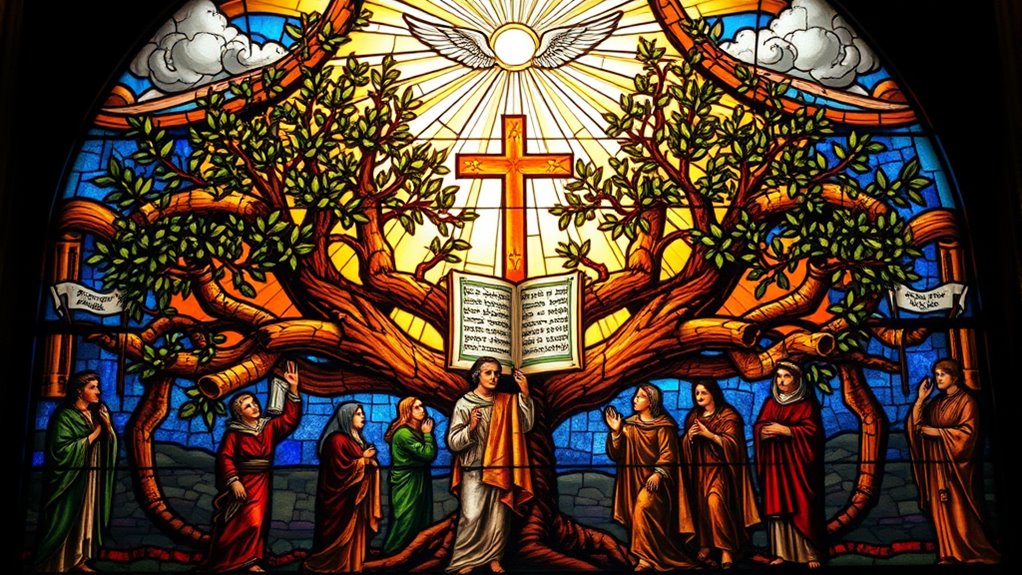
Romans 11 uses an olive tree metaphor, portraying Israel as the enduring root and Gentiles as grafted branches sharing the same nourishment. Romans 10 states plainly: “There is no distinction between Jew and Greek,” affirming that all who call on the Lord receive the same inheritance. Catholics, who accept authority from the Bible, Sacred Tradition, and the Magisterium, also affirm this unity as central to the Church’s mission and identity three sources of authority.
Modern Christian Understanding of Jewish-Christian Relations

During the latter half of the 20th century, Christian churches worldwide undertook a critical reappraisal of 2,000 years of anti-Jewish teaching and practice. Vatican II’s Nostra Aetate in October 1965 marked a watershed moment, directing Roman Catholic teaching to be purged of references offensive to Jews and Judaism.
Theologians across the Christian spectrum have since rejected supercessionism—the doctrine that Christianity replaced Judaism—and now emphasize the close relationship between the two faiths rather than theological opposition. Many Christian theologians affirm that Jews and Christians worship the same God. Modern scholarship understands Jesus as a practicing Jew, leading Christians to deeper respect for Judaism.
The exclusivist view claiming Christianity as the sole path to salvation has been increasingly challenged, with recognition that multiple paths to the divine exist. The Roman Catholic Church now encourages Scripture use in ways that respect Jewish tradition and often recommends Catholic-approved translations such as the NABRE for liturgical and study purposes.