








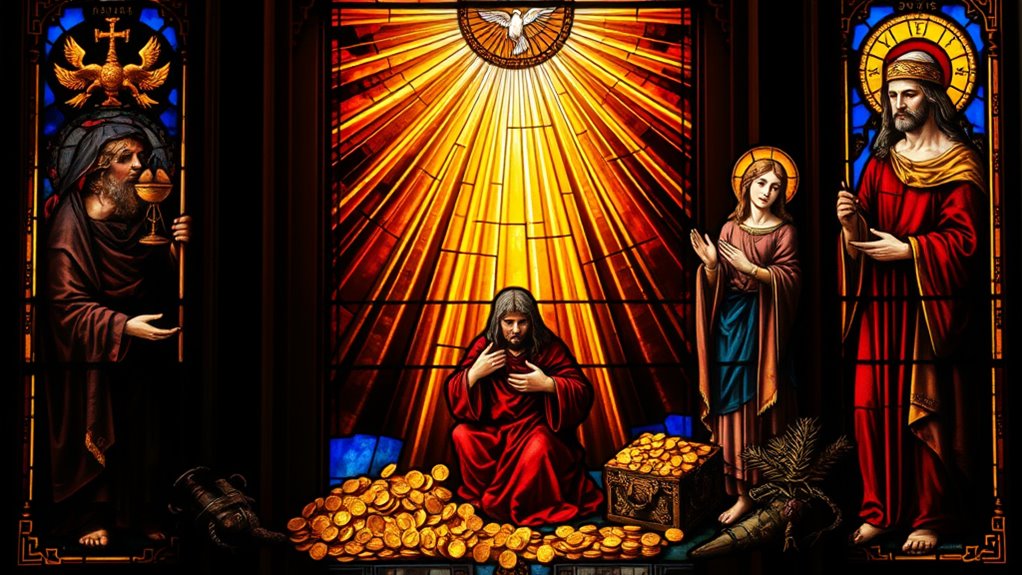
The Bible does not treat wealth as sinful but frames it as a stewardship issue centered on heart condition. Deuteronomy 28 connects material provision with obedience, while Jesus warned in Matthew 6 that earthly treasure is temporary and that no one can serve both God and money. First Timothy 6:10 identifies the *love* of money, not money itself, as a root of all kinds of evil. What Scripture requires of the wealthy — and how some handled it well — runs deeper than most expect.
Key Takeaways
- The Bible does not treat wealth as sinful but as a stewardship issue, focusing on heart condition and responsible use.
- Material wealth can reflect God’s blessing, as seen in Deuteronomy 28, when paired with obedience and righteousness.
- Jesus warned that wealth becomes dangerous when it replaces trust in God or competes with devotion to Him.
- Scripture requires the wealthy to remain humble, practice generosity, fund good works, and never oppress vulnerable people.
- The love of money, not money itself, is identified in 1 Timothy 6:10 as a root of all kinds of evil.
Does the Bible Say Wealth Is a Sin?

One of the most persistent misunderstandings in Christian thought is that the Bible treats wealth itself as sinful. Scripture, however, draws a clear distinction between possessing wealth and loving wealth. Biblical teaching consistently frames money as a stewardship issue rather than a guilt issue.
The Bible does not treat wealth as sinful — it treats wealth as a matter of stewardship.
Some Christian sources explicitly state that “poverty is not a virtue” and “wealth itself is not sinful.” The Bible’s criticism centers on misuse, not ownership.
Deuteronomy 28:1–8 even describes material provision as part of God’s blessing for obedience. Wealth is presented as compatible with faith when paired with generosity and righteousness.
Scripture does not teach that poverty automatically equals holiness or that riches automatically equal sin. The determining factor, according to biblical teaching, is the condition of the heart.
God is sovereign over every financial condition, granting wealth and sending poverty according to His purposes. God grants wealth as part of His sovereign design, meaning its presence in a believer’s life carries both privilege and responsibility.
The Old Testament contains approximately 23,145 verses, which shows the breadth of instruction on many topics including wealth and stewardship.
Bible Gateway, a widely used resource for studying these scriptures, is currently not available in certain regions, though a new solution is actively being developed to restore access for affected users.
What Jesus Actually Warned Rich People About Money

When Jesus addressed the subject of money, his warnings were specific and pointed, targeting not wealth itself but the patterns of thinking that wealth can quietly encourage.
He told listeners to guard against covetousness, stating that life does not consist in the abundance of possessions. The Catholic canon includes deuterocanonical books that expand the scriptural context for teachings about possessions.
He described earthly treasure as temporary, vulnerable to moth, rust, and theft.
His camel-and-needle illustration stressed how easily trust in riches replaces trust in God.
He also taught that no one can serve both God and money, framing wealth as a competing loyalty rather than a neutral resource.
To the rich young ruler, he offered a direct challenge: sell, give, and follow.
In the parable of the sower, he described how wealth works against spiritual growth, with the word becoming choked by riches and the cares and pleasures of life.
In the parable of the rich fool, he illustrated the folly of a man who had accumulated great material wealth but was poor toward God.
The consistent concern across each warning was the direction of the heart.
Rich People in the Bible Who Used Wealth Well

Jesus’ warnings about wealth focused on where the heart settles, not on whether wealth itself is permissible. Scripture records several figures who held significant resources and used them responsibly.
Abraham was wealthy in livestock, silver, and gold, yet directed that wealth toward worship and hospitality rather than accumulation. The Catholic tradition notes that biblical canons preserving such stories include deuterocanonical books that were part of the Septuagint.
Job, considered the greatest among the people of the East, fed the poor, supported widows, and opened his home to the afflicted.
Boaz ordered extra grain left in his fields so Ruth, a foreign widow, could eat.
Lydia, a seller of purple cloth, immediately offered her home to support Paul’s missionary work.
Joseph of Arimathea provided his own tomb for Jesus’ burial, using private property for a public act of reverence at considerable personal risk.
Dorcas was known throughout her community for acts of charity, consistently using her resources to clothe and care for those in need, embodying what it means to be a righteous rich steward.
The Macedonian churches, though living in extreme poverty themselves, begged for the opportunity to give toward the relief of other believers, demonstrating that generosity transcends wealth.
What God Requires of Wealthy People

Scripture does not leave wealthy people without direction. The Bible outlines specific expectations for those with financial resources.
First, wealth must not produce pride. Paul instructs the rich not to become haughty or place confidence in uncertain riches, but instead to trust God. Regular daily reading of Scripture helps wealthy people keep their priorities aligned with humility.
Second, wealth must fund good works. Being “rich in good works” is a direct biblical command, connecting money to active service.
Third, generosity is required. Proverbs links kindness toward the poor with honor before God.
Fourth, the rich are forbidden from oppressing vulnerable people. Landowners in Israel were even required to leave portions of their harvest for the poor and foreigners.
Fifth, Proverbs teaches that lending to the poor is equated with lending to the Lord himself, making financial generosity an act of direct devotion.
Finally, Scripture calls wealthy people to hold possessions with an eternal perspective, treating wealth as stewardship rather than identity. Jesus teaches that Christians carry financial obligations toward both God and fellow man.
Why the Love of Money Matters More Than Money Itself

The Bible draws a careful distinction between possessing money and loving it. First Timothy 6:10 does not condemn wealth itself but identifies the craving for it as “a root of all kinds of evil.” Some who pursued money, the verse notes, “wandered from the faith” and brought themselves lasting grief. Many beginners find that consistent prayer helps reorient priorities away from material craving.
Luke 12:15 reinforces this by stating that life’s meaning does not rest in accumulated possessions. Ecclesiastes 5:10 adds a practical observation: whoever loves money never reaches satisfaction.
The biblical concern is less about bank accounts and more about what desire does to a person’s heart, priorities, and spiritual direction.
Hebrews 13:5 offers a quieter alternative, pairing freedom from money-love with contentment and trust, treating those qualities as more reliable than wealth itself. Those who are rich are instead instructed to place their hope in God, who richly provides everything for their enjoyment. Scripture also calls believers to flee these things and actively pursue righteousness, godliness, faith, love, perseverance, and gentleness in their place.