Catholic teaching holds that Mary must be Queen because she is the Mother of God, the eternal King. Pope Pius XII grounded her royal dignity in divine maternity and cooperation with Christ’s saving mission, most fully expressed in his 1950 definition of the Assumption. Her queenship is not independent but entirely derivative, flowing from Christ’s kingship and conformity to his victory. Those who explore further will find this title carries surprising depth.
What Makes Mary a Queen in the First Place?
Before examining what the Church teaches about Mary’s role, it helps to ask a foundational question: why is she called a queen at all?
Catholic teaching offers several grounded answers.
The most central comes from her identity as the Mother of God.
Pope Pius XII, writing in *Ad Caeli Reginam*, explained that Mary holds royal dignity because she is the mother of the divine King.
In *Ad Caeli Reginam*, Pius XII grounded Mary’s royal dignity in one fact: she is the mother of the divine King.
Additionally, her close cooperation in Christ’s saving work deepens that connection.
Her title is always understood as subordinate to Christ, derived from him rather than claimed independently.
It reflects honor, not independent authority.
The ancient prayer Sub Tuum Praesidium, dating to the third century, shows early Christians already invoking Mary as a powerful intercessor reflecting queenly authority.
Vatican II affirmed this dignity in *Lumen Gentium* 59, teaching that Mary was exalted as Queen of all to be conformed to her Son.
This understanding also corresponds to how the Holy Spirit works in believers, bringing about conformity to Christ and enabling the Church’s devotion to Mary.
Why Christ’s Kingship Makes Mary a Queen
Having established why Mary holds royal dignity at all, the next question follows naturally: where does that dignity come from, and why does it hold?
Catholic teaching answers clearly: Mary’s queenship flows entirely from Christ’s kingship.
Pius XII taught that Christ alone is King in the full sense, while Mary shares in that dignity through her role as his mother.
Benedict XVI added that she is Queen precisely because she is uniquely conformed to her Son.
Her title carries real meaning, but it remains derivative and subordinate, always pointing back to Christ rather than standing apart from him. Vatican II’s *Lumen Gentium* 59 affirms that Mary was exalted by the Lord as Queen so as to be more fully conformed to the Lord of Lords.
This accords with the biblical emphasis on Christ’s self-giving love, which is the model for Mary’s participation in his reign through agape sacrificial love.
How the Assumption Crowned Mary Queen of Heaven
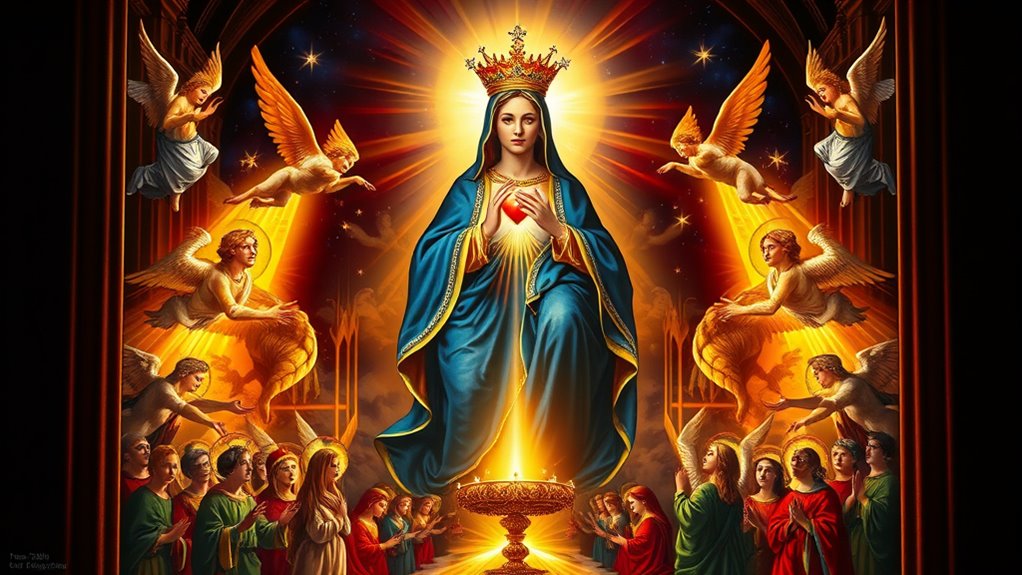
The Assumption stands as the dogmatic turning point in Catholic teaching on Mary’s heavenly dignity. Defined by Pope Pius XII on November 1, 1950, it holds that Mary was taken body and soul into heavenly glory. From that moment, Catholic teaching presents her coronation as a direct consequence.
The Assumption marks the pivotal moment when Catholic teaching establishes Mary’s entrance into heavenly glory, body and soul.
Four facts ground this connection:
- *Munificentissimus Deus* describes Mary seated as Queen beside her Son.
- The Assumption feast falls August 15.
- The Queenship feast follows August 22.
- Vatican language calls her “Queen of the universe” after her Assumption.
Many bishops cite Genesis 3:15 as primary scriptural confirmation of Mary’s Assumption, grounding her queenly dignity in the earliest promises of sacred Scripture. Genesis 3:15 is understood as the foundational biblical warrant upon which the entire theological edifice of Mary’s glorification rests.
The Queenship feast on August 22 was instituted by Pope Pius XII in 1954 through the encyclical Ad coeli Reginam, formally establishing Mary’s royal dignity as a natural extension of her Assumption one week prior. The Church teaches that Scripture itself attests to the Bible’s purpose for teaching and correction, which supports the theological interpretation of Mary’s role.
Mary’s Queenship in Redemption and the Life of the Church
Mary’s queenship, as Catholic teaching presents it, does not rest on ceremony alone but on her direct participation in the work of redemption. Pius XII taught that her royal dignity flows from her divine maternity and her cooperation with Christ’s saving mission, particularly at the Cross.
That cooperation was not passive. She freely offered Jesus and remained united to his redemptive work. *Lumen Gentium* 59 connects her queenship to ongoing conformity with Christ, “Lord of lords and conqueror of sin and death.” Mary as disciple continued to exemplify humble service as seen in Scripture and tradition.
Her role continues through intercession, distributing graces that flow from Christ’s victory to the wider Church. The encyclical identifies two foundations for Mary’s queenship: her divine motherhood and her outstanding part in the work of eternal salvation. The Assumption was declared dogma by Pope Pius XII in 1950, establishing the foundation upon which her Queenship title was formally proclaimed just four years later.
Why Catholics Trust Mary as Their Heavenly Queen?
When Catholics speak of trusting Mary as their heavenly queen, they are describing something specific: confidence in her intercession before Christ, not worship of an independent divine power.
*Ad Caeli Reginam*, the 1954 encyclical of Pope Pius XII, grounded that trust in her divine motherhood, her cooperation with Christ’s redemptive work, and her singular election by God.
That trust rests on four recognized points:
That trust rests on four recognized points, each anchoring Marian devotion firmly within Christ-centered faith.
- Her will aligns completely with Christ’s
- Her intercession is maternal, not authoritative
- Her queenship is created honor, not divinity
- Approaching her draws believers closer to Christ
The encyclical also consecrated the human race to the Immaculate Heart of Mary as an expression of her maternal queenship over all the children of grace.
Angels, as described in Scripture, are created spiritual beings who serve God and minister to believers, which supports the idea of a heavenly court in which Mary intercedes for humanity.