
The Bible describes giants across multiple eras and groups. The Nephilim appear in Genesis 6:1–4 as powerful pre-flood figures, while the Rephaim and Anakim inhabited Canaan before Israel’s arrival. Og of Bashan, identified as the last Rephaim king, slept in an iron bed measuring nine cubits long. Goliath of Gath represents the most recognizable example, though David’s soldiers encountered several giant-associated warriors. The full picture stretches further than most expect.
Key Takeaways
- The Bible mentions several giant groups, including the Nephilim, Rephaim, and Anakim, appearing across multiple books from Genesis through Samuel.
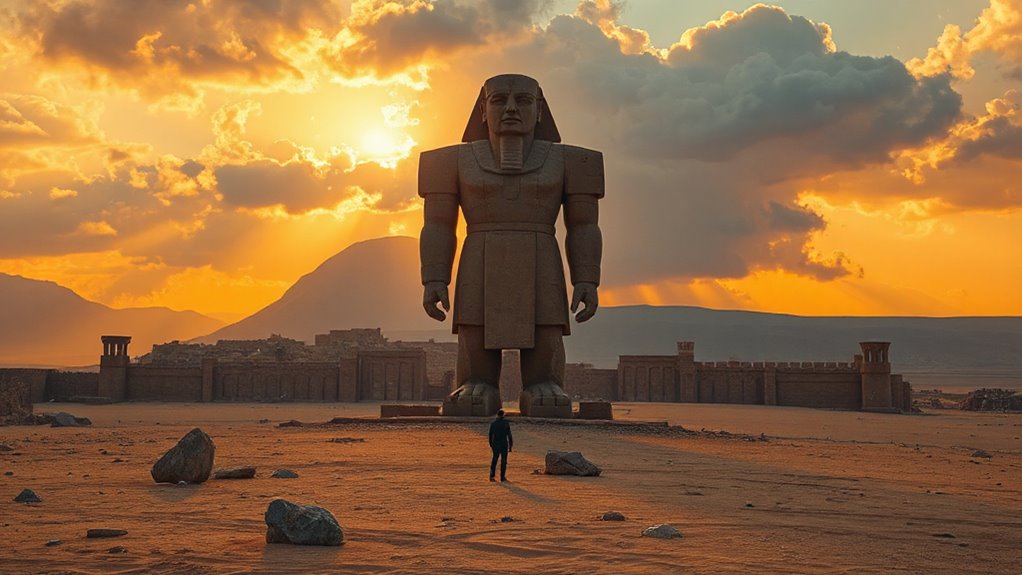
- Og, king of Bashan, is identified as the last of the Rephaim, with an iron bed measuring roughly nine cubits long.
- Israelite spies reported seeing Anakim in Canaan, describing themselves as grasshoppers by comparison, connecting Anakim to the Nephilim.
- Goliath of Gath is the Bible’s most prominent giant, killed by David, with other giant-associated Philistines defeated during his reign.
- Giants function narratively as symbols of chaos and divine judgment, marking transitions between major biblical eras and amplifying God’s authority.
Who Are the Giants in the Bible?
The Bible references several distinct groups and individuals described as giants, each appearing in different historical and narrative contexts across the Old Testament.
The Nephilim appear first in Genesis 6:1–4, introduced as mighty men connected to a pre-flood world. The Catholic canon includes books that reference ancient traditions relevant to these accounts.
The Rephaim surface as an ancient Canaanite people, with Deuteronomy 3:11 identifying Og as their last known king.
The Anakim, linked to both the Nephilim and Rephaim traditions, were feared inhabitants of Canaan’s southern hill country near Hebron.
Numbers 13:33 connects both the Anakim and Nephilim through the report of Israelite spies.
Goliath, the Philistine champion from Gath, stands as the most recognized individual giant, his story recorded in 1 Samuel 17 and later tied to the broader Rephaim tradition.
Og, king of Bashan, ruled over sixty walled cities, with his capital identified as Ashtaroth in Bashan, a place name that also appears in ancient Ugaritic texts connecting the region to the Rephaim tradition.
Giants played a defining role in Israel’s story, as Israel’s initial refusal to enter the Promised Land was driven by fear of the giant inhabitants encountered in the spy report of Numbers 13.
The Giants in the Bible the Israelites Actually Faced
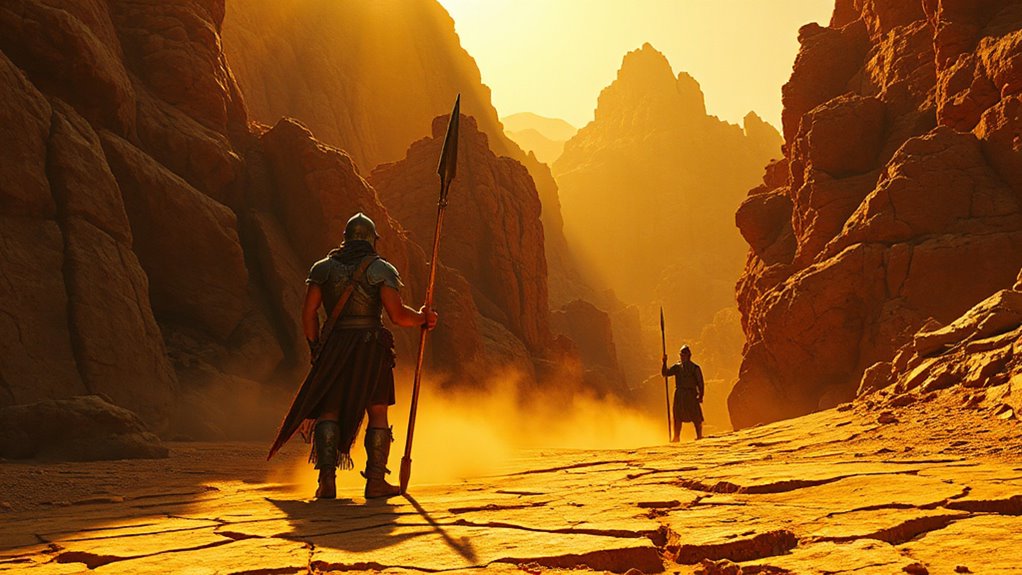
Before Israel ever crossed the Jordan River, its armies had already begun encountering the giant-associated peoples recorded in the biblical text.
Sihon, king of the Amorites, and Og, king of Bashan, were defeated east of the Jordan.
Deuteronomy identifies Og as the last of the Rephaim.
Once inside Canaan, Joshua confronted the Anakim, eventually driving them into coastal cities like Gath, Gaza, and Ashdod.
Joshua drove the Anakim from Canaan’s interior, pushing them into coastal strongholds at Gath, Gaza, and Ashdod.
Later, during David’s reign, giant-associated Philistine warriors emerged from those same cities.
Goliath of Gath was the most prominent.
Warriors like Sibbecai the Hushathite and Elhanan the Bethlehemite killed others.
One opponent at Gath had six fingers and six toes.
These encounters stretched across generations, from the wilderness campaign through the early monarchy.
Og’s iron bed, recorded in Deuteronomy 3:11, measured nine cubits long and four cubits wide, suggesting Og exceeded eleven feet in height.
The Amorites, described by Amos as having a height like the height of cedars, were among the most frequently mentioned giant-associated peoples in Scripture, appearing more than eighty times across the biblical text.
Jesus, ethnically Jewish and rooted in first-century Palestinian society, inherited a religious tradition that remembered and interpreted these ancient narratives.
The Real Meaning of Giants in the Biblical Narrative
Across the biblical text, giants carry a meaning that extends well beyond their physical dimensions. Scholars note that figures like the Nephilim in Genesis 6:1–4 function primarily as narrative markers, signaling disorder, transgression, and a world moving toward judgment. Their presence reinforces the idea that unchecked rebellion leads to collapse.
Giants also serve as historiographic cues, marking stages between eras and preserving memory of a legendary past. In stories involving direct conflict, their size amplifies the stakes, exposing human vulnerability and highlighting divine authority. Observations from ancient cultures about lunar eclipses and changing star visibility contributed to the broader ancient understanding of the world that frames these narratives.
Rather than simple biological curiosities, giants in the biblical tradition dramatize the tension between divine order and human or cosmic defiance. Their defeat consistently signals that strength and scale offer no protection against God’s purposes. The Rephaim, for instance, appear in two distinct roles across the biblical text, functioning as both spirits of the dead and as races of literal giants opposing Israel.
The term Nephilim itself carries deep etymological uncertainty, with many translations rendering it as “giants” due to Septuagint influence on translation, while other proposed derivations from the Hebrew root n-p-l suggest meanings such as “fallen ones” or those who cause others to fall.