
Saint Augustine emerged from the fertile coastal plains of Roman North Africa, a region encompassing present-day Tunisia and Algeria that exported grain and olive oil across the Mediterranean. His identity reflected complex layers of Roman authority over indigenous Amazigh cultures, particularly in Africa Proconsularis where Latin served as the language of commerce and Carthage functioned as the cultural center. Augustine’s theological battles against the Donatist schism revealed social tensions between Romanized coastal elites and up-country Numidian communities resisting central authority. The Vandal invasion of 429 ultimately reshaped this world as Augustine lay dying during Hippo’s siege, connecting his African experience to broader questions about covenant and belonging that continue to illuminate his work.
The world that shaped Saint Augustine stretched across the fertile coastal plains of Roman North Africa, a region encompassing present-day Tunisia, Algeria, and parts of Libya and Morocco. This Maghreb territory served as a major exporter of grain and olive oil to Rome, with the olive press appearing so frequently in daily life that Augustine incorporated it as a metaphor in his sermons. The region had been integrated into the Roman Empire for five centuries following Carthage‘s destruction, yet beneath this Roman veneer, indigenous Amazigh and Numidian cultures maintained vibrant traditions.
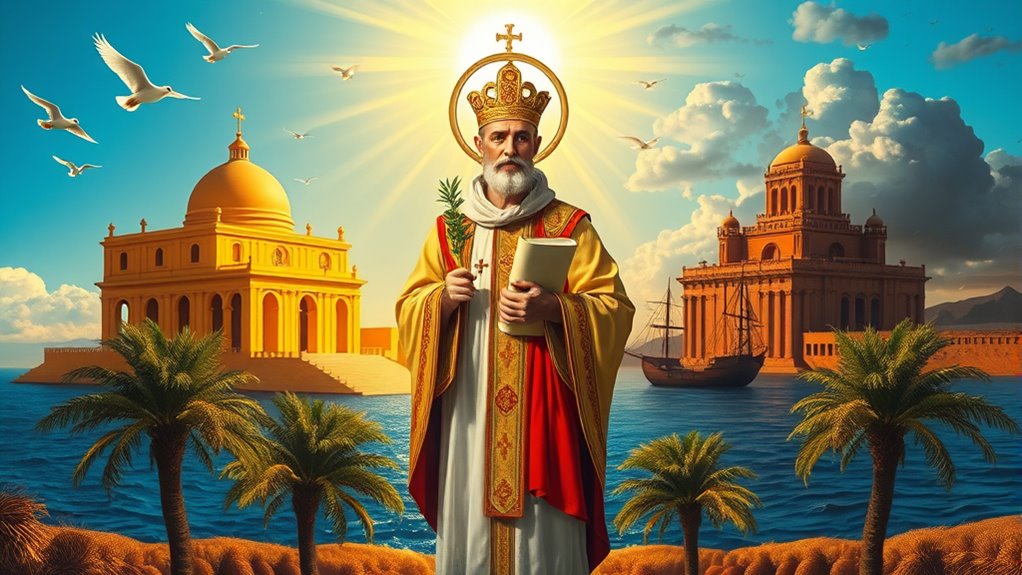
Augustine’s North Africa: five centuries of Roman rule layered over indigenous cultures, its olive presses grinding oil and metaphors alike.
Latin functioned as the language of commerce and culture, and Carthage had been rebuilt as the metropolis of Roman Africa. Augustine identified with Africa Proconsularis, the most Romanized zone, rather than with Mauretania or the less-Romanized interior regions of Numidia. This distinction mattered because African identity emerged not from uniform culture but from complex layers of Roman authority overlaying indigenous populations who had been displaced to southern borders.
The Donatist schism revealed these tensions. Emerging from disputes over legitimate baptisms after the Great Persecution, the Donatists formed what many considered the majority church in North Africa. Their strongest support came from up-country Numidia, where communities resisted central Roman authority and linked Christianity closely to North African identity. Augustine firmly opposed this movement, aligning himself with the Roman Catholic church.
As bishop of Hippo in the early 390s, Augustine faced a city where Donatists commanded the larger congregation. He organized formal debates, planned imperial delegations to secure suppressive edicts, and led the rhetorical campaign that demolished Donatist arguments at a Carthage conference. The conflict turned violent, with ambushes on travelers, sectarian propaganda in songs and posters, and bloody assaults in the countryside. Augustine advocated forced assimilation.
The Vandal invasion of summer 429 reshaped everything. Meeting little resistance, the Vandals besieged Hippo in spring 430 as Augustine lay dying. Citizens fled to the fortified city, overwhelming its capacity. One miracle was recorded during the siege: the healing of an ill man. The regional order Augustine defended was collapsing. The biblical themes of covenant, land, and the formation of a people traced from the patriarchs to the monarchy help illuminate how Augustine and his contemporaries understood community and divine promise in their own African context, linking local identity to broader scriptural narratives about covenantal promises.