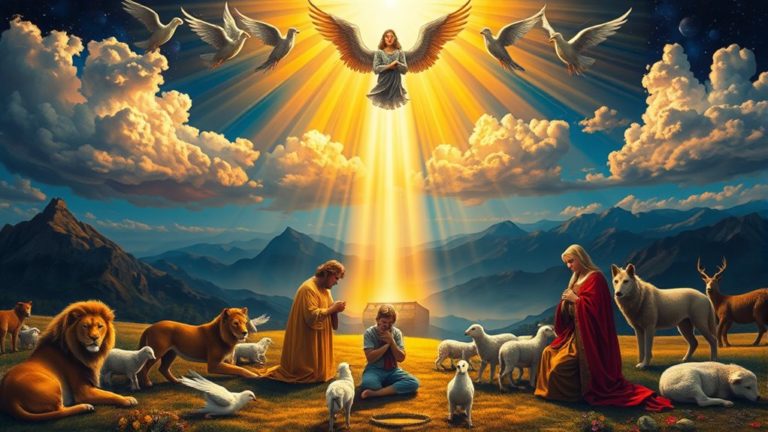

The Noahic Covenant, found in Genesis 9:1–17, contains no conditions, required obedience, or human obligations. God simply declares, “I establish My covenant with you,” making the promise entirely his own. The word “covenant” appears seven times in just ten verses, signaling deliberate emphasis. Its scope extends to all humanity, every living creature, and the earth itself. John Calvin described it as grace extended to all nations in common. The rainbow and its deeper meaning still await closer examination.
What Makes the Noahic Covenant Unconditional?
Unconditional covenants are rare in Scripture, and the Noahic Covenant stands as the clearest example of one.
Unconditional covenants are rare in Scripture, and the Noahic Covenant stands as the clearest example of one.
Genesis 9:1–17 contains no “if” clause, no required obedience, no demanded sacrifice, and no condition Noah or his descendants must meet. God simply declares, “I establish My covenant with you” (Genesis 9:9–11), making the promise entirely His own.
Scholars distinguish this from conditional agreements like the Mosaic Covenant, which carries clear stipulations.
The Noahic Covenant proceeds solely from God’s character and faithfulness, meaning human wickedness cannot void it. Its unconditional nature reflects grace operating independent of human merit or performance. Notably, the covenant’s promise does not preclude future destruction of the earth by other means, such as fire, as referenced in 2 Peter 3:10–11 and Revelation 20:9.
The word “covenant” appears seven times in Genesis 9:8–17, underscoring how deliberately and thoroughly God defined this pledged relationship with Noah, his descendants, and every living creature. This covenant also echoes God’s earlier promises to the patriarchs and the theme of Israel’s identity woven through Scripture.
Who Does the Noahic Covenant Actually Cover?
Having established that the Noahic Covenant carries no conditions, the next reasonable question concerns its reach: who exactly falls within its boundaries?
The covenant extends far beyond a select group. Genesis 9:9 uses Hebrew plurals pointing to Noah’s three sons—Shem, Ham, and Japheth—and all their descendants, meaning every nation that followed. Scholars describe Noah as a “new universal head,” making the covenant’s coverage genuinely global. This universal scope helps explain why some theologians connect it with broader biblical calls to thankfulness and trust.
Its beneficiaries include:
- All humanity, faithful or wicked
- Every living creature on earth
- The earth itself as recipient
- Future generations until Christ’s return
Calvin himself described the Noahic covenant as a covenant of grace extended to all people and nations in common.
Some theological perspectives have challenged this universal reading, arguing instead that the covenant was addressed to the eight individuals aboard the Ark and that unbelievers receive only spillover benefits as secondary recipients rather than direct covenant members.
What the Rainbow Signifies in Genesis 9
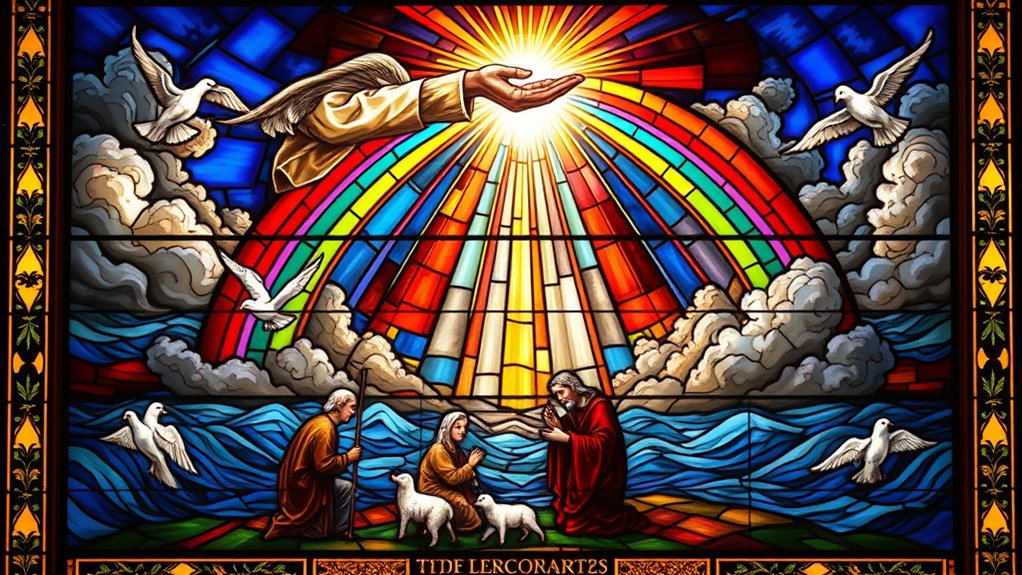
The rainbow that appears in Genesis 9 carries meaning that extends well beyond its familiar role as a weather phenomenon. The Hebrew word behind it, *qeshet*, actually means “war bow,” a weapon associated with power and judgment. Ancient readers would have recognized a warrior setting his bow aside after battle. Here, God figuratively hangs his weapon in the sky, signaling ceased hostilities. Genesis 9:13–15 frames the rainbow as a divine reminder of the covenant’s terms. It assures every generation that no second global flood will occur, pointing instead, theologians note, toward Christ’s redeeming mercy in Isaiah 54:9–10. In Revelation 4:3, the rainbow surrounding God’s throne visually underscores that covenantal mercy remains central to his eternal reign. The sign also connects to broader biblical themes of judgment and restoration, which appear throughout prophetic literature. The physical phenomenon itself reflects remarkable precision, as sunlight refracting and dispersing through water droplets produces an ordered color spectrum at consistent, predictable angles, suggesting intentional calibration of the very optical laws that make the sign visible.