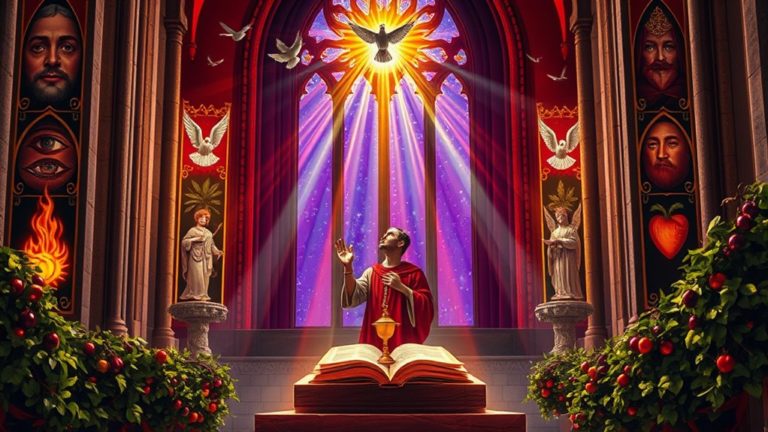

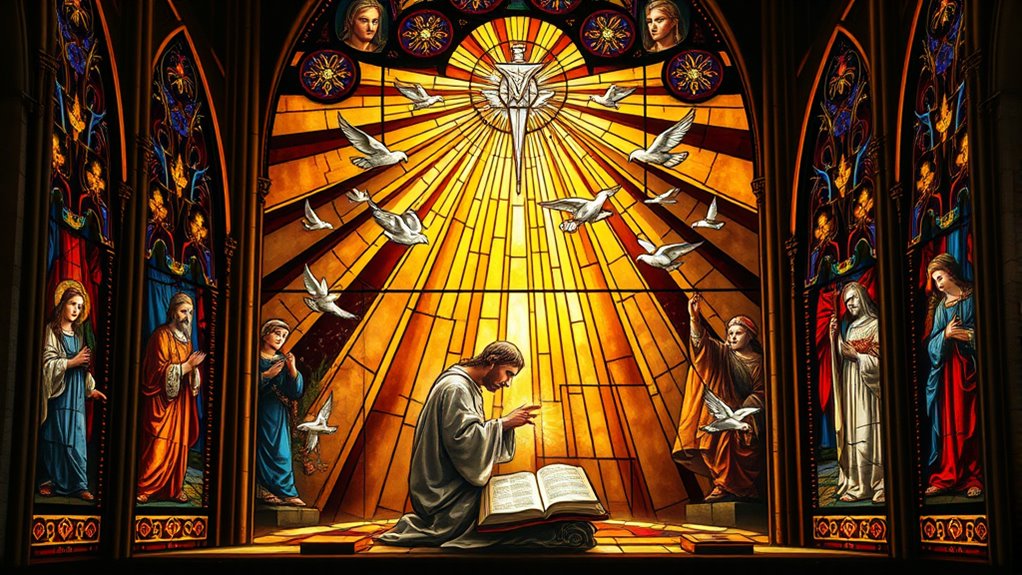
The phrase “Love God With All Your Imagination” frames imagination as a core spiritual faculty, not a secondary gift. Rooted in the Hebrew concept of *yetser*, imagination shapes thought before action forms. Scripture references like Romans 12:2 and Jeremiah 31:33 treat it as a faculty requiring active renewal and divine direction. Jesus modeled this through parables, inviting mental and emotional participation in kingdom truth. Those curious about applying these ideas practically will find the full picture ahead.
Why God Designed You for Holy Imagination
Among the distinguishing marks of human beings, one stands out as particularly significant: the capacity for imagination. Unlike dogs, which operate on instinct, humans can envision possibilities that do not yet exist.
Theologians connect this ability to the Hebrew term *yatsar*, meaning to fashion something in the mind before forming it physically. This mirrors God’s own creative method.
Scripture describes imagination as a facet of the *imago Dei*, the image of God imprinted on humanity. No other creature shares this capacity.
God designed it deliberately, intending humans to engage transcendent reality and participate meaningfully in His ongoing creative purposes. Humanity alone was formed to bear rational and volitional agency, reflecting God’s own intellect and freedom in every act of creative thought. The Holy Spirit also enables believers to discern and participate in God’s creative purposes through spiritual guidance.
What the Bible Actually Says About Holy Imagination
The Bible treats imagination not as a minor mental quirk but as a defining spiritual faculty, one capable of moving a person toward God or away from Him depending on how it is governed.
Imagination is not a minor mental quirk. It is a defining spiritual faculty with eternal consequences.
The Hebrew word *yetser* means “a shaping” or “a forming,” describing the mind’s capacity to conceive and plan.
Genesis 6:5 warns that unchecked imagination produces only evil.
Prayer likewise channels imagination toward God by shaping thoughts, confession, and desire into spiritual communication with Him communication with God.
Yet Romans 12:2 calls for transformation through renewed minds, and Jeremiah 31:33 promises God will write His law directly onto human hearts, redirecting imagination toward something purposeful, holy, and genuinely creative.
Hebrews 11:1 describes faith as the substance of things hoped for, meaning hope fuels faith by supplying it with the mental picture of what is desired and believed.
Christian meditation, unlike eastern practices that empty the mind, is defined by filling the mind with God’s Word, inviting imagination to serve as a faculty for encountering the living Lord through Scripture.
How Jesus Used Holy Imagination to Reveal Kingdom Truth
When Jesus taught, He rarely stated kingdom truths in plain propositional terms. Instead, He used parables, metaphors, and vivid images to require listeners to make imaginative leaps.
He told Nicodemus a person must be “born again,” pushing the Pharisee beyond physical categories into spiritual ones. He referenced Moses lifting the serpent in the wilderness to illustrate faith. He described the Spirit like wind, invisible yet undeniable.
Pastor Brian Zahnd notes the Holy Spirit uses imagination as the means by which people perceive kingdom realities. For Jesus, imagination was not decoration. It was the doorway into understanding.
His parables were heavenly stories designed to declare the truths of God’s Kingdom through narrative, inviting listeners to participate mentally and emotionally in scenes like a prodigal son returning home or a father breaking into a run. Scripture makes clear that imagination traces back to the Father, meaning this creative capacity was never meant to be neglected but fully engaged in the pursuit of kingdom understanding. The Bible also presents Scripture itself as inspired authority, given to teach, correct, and guide believers toward spiritual transformation.
How to Practice Holy Imagination Every Day
Practicing holy imagination does not require special training or unusual spiritual gifts — it requires only a willing mind, a quiet space, and a Gospel passage.
Holy imagination asks little of you — only an open mind, a moment of stillness, and Scripture.
Practitioners read the passage slowly, close their eyes, and let the scene develop naturally, engaging all five senses.
Key daily practices include:
- Designating a consistent, distraction-free time and place
- Reading the selected passage multiple times before visualizing
- Engaging smell, sound, texture, and temperature within the scene
- Placing oneself inside the narrative as a participant
- Journaling observations and emotional responses afterward
The Holy Spirit, practitioners report, often uses this structured freedom to surface unexpected truths. This practice is also known as Ignatian contemplation, a method rooted in listening for God through the imagination.
Ignatius of Loyola discovered this method not in a monastery but during a forced bedridden recovery, where reading about the life of Christ led him to notice that imagining following Jesus produced lasting inspiration and joy, while other daydreams left only emptiness behind. The practice bears continuity with biblical themes of Sabbath rest found in Scripture.
How Holy Imagination Shapes the Stories You Already Tell
Once a person learns to meet Scripture with open imagination, that same capacity quietly begins to shape the stories they write, speak, and share.
Theologian Sarah Hylen notes that imagination is essential to faithful biblical interpretation, and that principle extends outward.
When someone regularly practices imagining gospel scenes, their natural storytelling shifts.
Characters gain interiority.
Scenes carry symbolic weight.
Details are chosen with care rather than convenience.
Holy imagination, described as dwelling between the divine and the physical, gives storytellers a way to mirror both worlds simultaneously, producing narratives that feel grounded yet reach toward something larger than the visible moment.
Scripture itself overflows with images, metaphors, parables, and poetry, nourishing the imagination as much as the mind and will, so the storyteller formed by it carries that richness into every narrative they craft. This is why Bible beauty stands alongside goodness and truth as foundational to education.
Theological imagination, at its best, is confidence in God’s words applied through faith to believe incredible truths because God says them, and the storyteller who carries that posture brings a quiet authority to every narrative they shape.
Faith is shown not only in belief but in obedience and perseverance, which shapes how stories witness to God’s truth.