Around A.D. 500, Benedict of Nursia abandoned a privileged Roman education, rejecting wealth and civic life he found spiritually compromised. He retreated to Subiaco, then Monte Cassino, structuring his days around prayer, silence, and ascetic discipline. His most striking experience came during a nighttime vigil, when an extraordinary light flooded his window and, according to Gregory the Great’s *Dialogues*, the entire world appeared gathered into a single ray. The vision’s deeper meaning shaped everything Benedict built afterward.
The Roman Student Who Walked Away From Everything
Around 480 CE, Benedict was born in Nursia, a town in central Italy, into a distinguished and wealthy Christian family. His family sent him to Rome for formal education, placing him on the standard path of a Roman aristocratic youth. Yet Benedict eventually walked away from that world. He left the city, rejected civic life, and chose solitude instead.
Gregory the Great’s *Dialogues* remain the primary account of this departure. What followed was a withdrawal organized around prayer, silence, and ascetic discipline—a quiet but complete turn away from everything his Roman upbringing had prepared him for. He eventually settled in Subiaco, before later making his way to Monte Cassino. There, he would go on to found the Benedictine monastery, a site that would become inseparable from his legacy and the place where he was ultimately buried alongside his twin sister, St. Scholastica. This life of retreat and community formation illustrates the significance of baptism as a public commitment and entry into a life shaped by Christian practice.
What Drove Benedict Away From Roman Society?
The decision to leave Rome was not simply a matter of geography. Benedict left behind a social order he found spiritually compromised. Roman and church sources describe the capital around A.D. 500 as morally disordered, with decadence making the Gospel’s demands seem nearly impossible to pursue. The city’s moral decline is often compared with scriptural warnings about moral corruption found in biblical texts.
Benedict, born into nobility, had been positioned for public success. Instead, a religious awakening led him to abandon wealth and family privilege.
Later tradition describes him choosing to become a “nobody.” He sought poverty, manual labor, and dependence on God, rejecting fame and status in favor of a quieter, more disciplined kind of life. He eventually withdrew to a cave known as the Sacro Speco near Subiaco, where he lived as a hermit removed from the world he had renounced.
His birthplace was Nursia, an Umbrian town in Italy, where his family occupied a position of comfort and social standing within what remained of Roman noble society.
What Did Benedict Actually See in His Famous Vision?
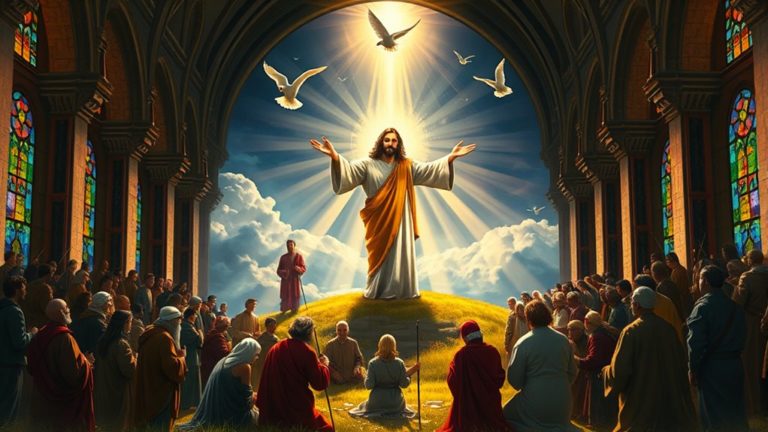
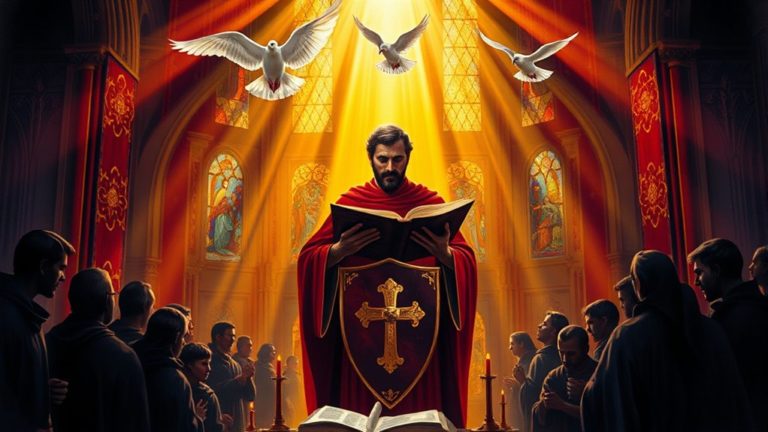
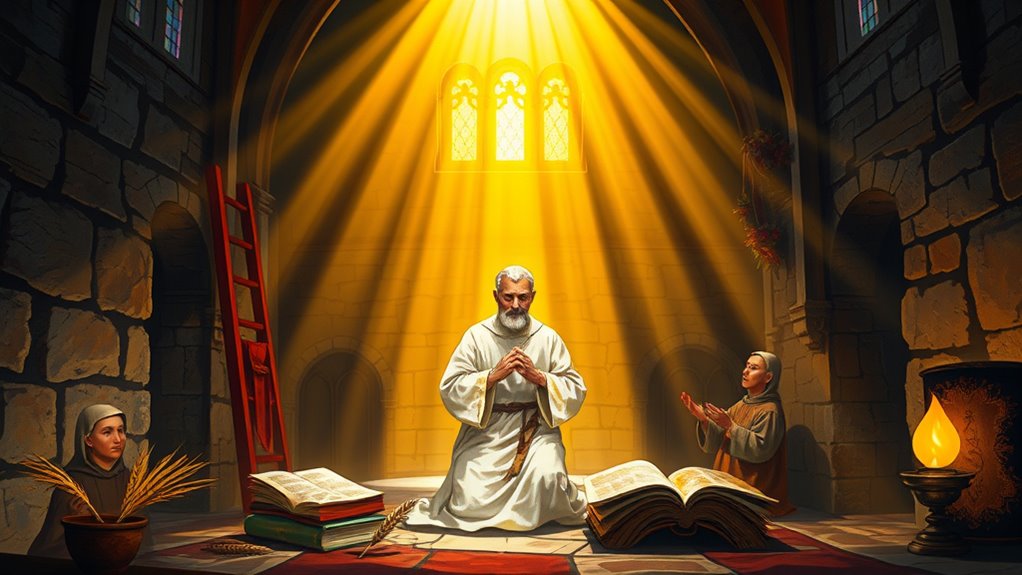
One night, while keeping vigil alone before Matins, Benedict stood at a window in prayer when the darkness around him suddenly gave way to an extraordinary light.
One night, Benedict stood alone at a window when sudden, extraordinary light broke through the surrounding darkness.
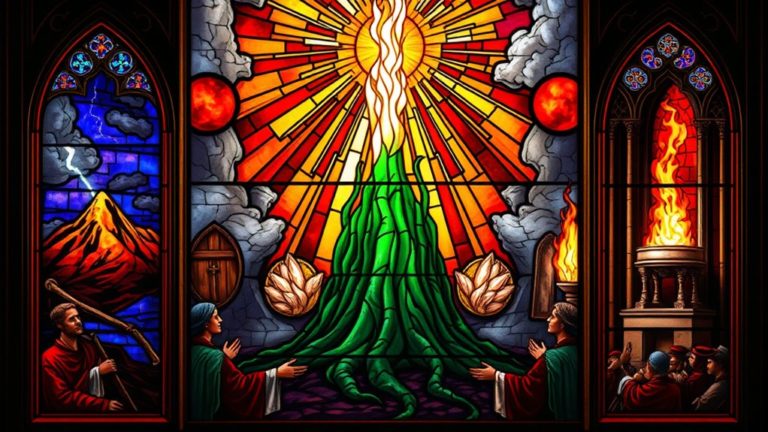
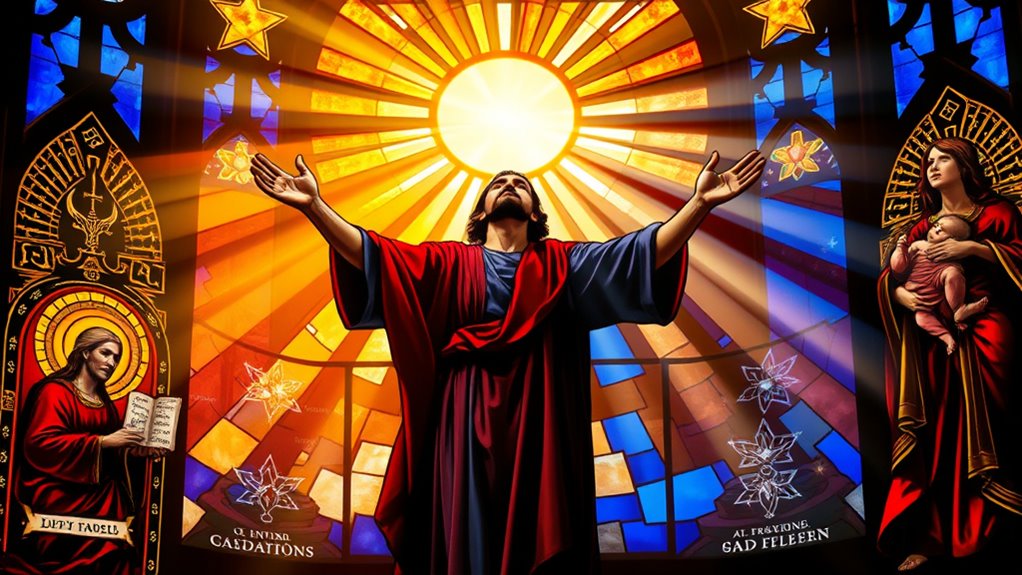
Gregory the Great, writing in his *Dialogues*, describes the light as brighter than daylight itself. Benedict then saw the entire world gathered before him, compressed into a single ray of light, suggesting a divine perspective over all creation.
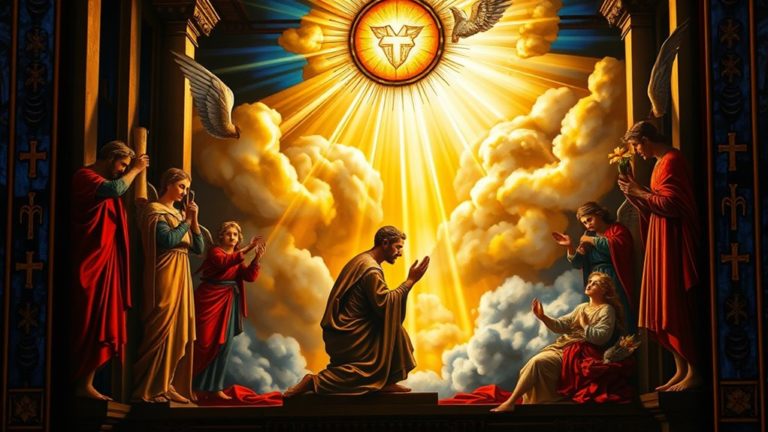
Within the same vision, he witnessed the soul of Germanus, Bishop of Capua, carried upward in a fiery globe by angels.
Benedict later described what he saw to Servandus the Deacon, who glimpsed only a fading remnant. This vision took place during Vigils, one of the seven times of prayer observed in the Liturgy of the Hours. Benedict’s twin sister, Saint Scholastica, founded an order for nuns based on the same rule of life he had established.
Benedict’s response to such revelations emphasized mercy and correction rather than harsh condemnation in how the community should live out such spiritual insights.
What Gregory the Great Said the Vision Meant
Gregory the Great did not leave Benedict’s vision without explanation. In his *Dialogues*, Gregory argued that Benedict saw the world gathered into a single beam of light because his soul had become fixed entirely on God.
This was not ordinary sight. Gregory connected the vision to contemplation, suggesting holiness produces a way of seeing shaped by divine truth.
He identified several meanings within the episode:
- Benedict perceived the spiritual and material orders together
- Created reality appeared within a unified divine view
- The vision demonstrated exceptional sanctity
- Holiness heightened Benedict’s spiritual understanding
- God granted Benedict a share in divine sight
Gregory clarified that the phrase “world gathered” did not mean heaven and earth contracted into a smaller space, but rather that Benedict’s soul had been enlarged by supernatural light above the world. The vision was later recognized by St. Gregory Palamas as placing Benedict within the hesychast tradition. A related motif can be compared with the biblical firmament concept which likewise frames how ancient authors pictured the ordered cosmos.
How the Vision Gave Benedict’s Rule Its Spiritual Foundation
Benedict’s original vision did not remain a private spiritual experience—it became the quiet foundation beneath his Rule for monks. His aim, described simply as seeking to please God alone, shaped the Rule’s entire direction.
Rather than a general moral code, the Rule became a practical guide for communal life ordered toward God. Self-will was to be renounced, prayer was structured into each day, and ascetic discipline served devotion rather than punishment. The emphasis on discernment and right ordering reflects the Bible’s teaching on wisdom as both practical and spiritual, rooted in fear of the Lord.
Pope Benedict XVI described Benedict’s life as steeped in prayer. That atmosphere, rooted in the original vision, gave the Rule its spiritual coherence and lasting character.
The Rule tempers the strict ascetic traditions of the East with gentleness and moderation, ordering communal life without imposing burdens too heavy for the imperfect to bear.
The Rule opens with a hortatory preface and frames the monastery as a school for the Lord’s service, establishing from its very first words that the life described within is one oriented entirely toward learning salvation.