
Around A.D. 60, St. Paul shipwrecked on Malta with 276 others, surviving by swimming or floating ashore on planks. During three months on the island, he reportedly survived a viper bite unharmed, healed the Roman governor Publius of fever and dysentery, and sparked widespread conversions. Publius later became Malta’s first bishop. St. Paul’s Catacombs, covering over 2,000 m² and awarded the European Heritage Label, stand as the island’s earliest archaeological evidence of Christianity — and the full story runs deeper still.
How St. Paul’s Shipwreck Gave Malta Its Catholic Identity
Few origin stories carry as much weight in a nation’s identity as Malta’s account of St. Paul’s shipwreck in A.D. 60.
According to tradition, the apostle arrived on the island after his vessel ran aground, then spent three months preaching and performing miracles. St. Luke is noted as having accompanied St. Paul during this period, traveling alongside him as a witness to the events that unfolded on the island.
After running aground, Paul spent three months on the island preaching and performing miracles.
His healing of Publius’s father reportedly led to Publius’s conversion, and Publius is traditionally named Malta’s first bishop.
That single event is credited with spreading Christianity across nearly the entire population. The islanders had already witnessed an earlier sign of Paul’s divine protection when, after a viper fastened itself to his hand, he shook the snake off into the fire and suffered no ill effects.
Aleteia describes Malta as carrying an unbroken Christian heritage spanning two millennia, rooted directly in that first-century landing. The Bible’s emphasis on spirits and postmortem realities also shapes how Maltese tradition interprets apostolic presence in local memory.
The Viper, the Governor, and Malta’s First Converts
When the storm-wrecked ship finally ran aground on Malta in A.D. 60, Paul was not arriving as a missionary but as a Roman prisoner bound for trial.
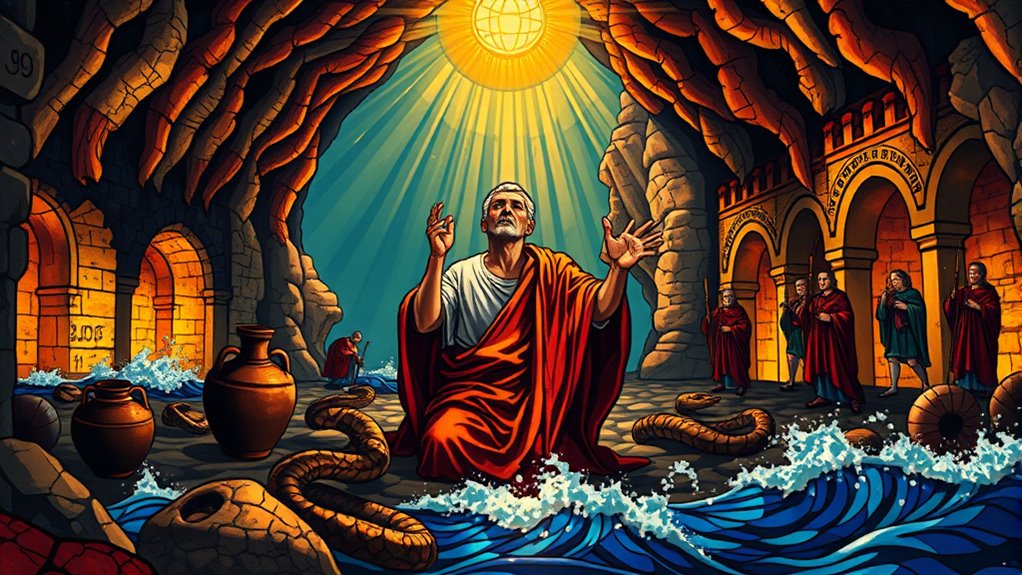
While gathering firewood, a viper fastened onto his hand.
The islanders expected him to swell up and die.
When he did not, they concluded he carried divine favor.
That perception opened doors.
Paul healed Publius, the Roman governor, of fever and dysentery.
Later tradition identifies Publius as Malta’s first bishop and a saint.
Within three months, Acts records, Paul had healed others and won converts, planting Christianity’s earliest roots on the island.
The site where Publius once received Paul is today marked by St. Paul’s Cathedral, Mdina, built on the same ground where that first encounter is said to have taken place.
The ship that wrecked carried 276 people aboard, all of whom survived by swimming or floating ashore on planks.
Many of the early converts would have navigated new questions of practice, including dietary laws that the New Testament addresses by emphasizing conscience and freedom.
From Viper Bite to Bishop: Malta’s Earliest Christians
What began with a viper bite and an unexpected healing grew, by tradition, into the foundation of Malta’s first Christian community.
The Roman governor Publius, reportedly healed through Paul’s intervention, converted to Christianity and is identified in local tradition as Malta’s first bishop.
The Cathedral of Mdina is said to stand on the site of his house.
Archaeological evidence supports an early Christian presence: St. Paul’s Catacombs, used through the 4th century, remain the largest physical record of that community.
Researched by Dr. A. A. Caruana in 1894, the site connects oral tradition with tangible, durable evidence. The catacombs are located on the outskirts of old Roman capital Melite, reflecting the Roman law that prohibited burials within the city.
Salini also preserves Paleo-Christian catacombs used as early burial sites for some of the first believers in the Mediterranean. Recent scholarship highlights the Bible’s claim of Scripture as divinely inspired and its role in guiding early Christian teaching and practice.
The Caves, Catacombs, and Churches Paul Left Behind
Scattered across the limestone landscape of Rabat and its ancient neighbor Mdina, the physical sites tied to Paul’s three-month stay on Malta form a layered record of tradition, devotion, and archaeology.
Across Malta’s ancient limestone hills, Paul’s brief stay left an enduring mark still visible in stone and tradition.
Key landmarks include:
- St. Paul’s Grotto, traditionally where Paul preached and sheltered
- St. Paul’s Catacombs, covering over 2,000 m² of early Christian burials
- More than 30 hypogea forming a vast funerary landscape outside ancient Melite
- Papal visits by John Paul II and Benedict XVI reinforcing the grotto’s significance
Heritage Malta identifies the catacombs as Malta’s earliest archaeological evidence of Christianity, used continuously from Roman through Byzantine periods. The catacombs were awarded the European Heritage Label, making them the first site in Malta to receive this recognition. Roman law forbade burial within city limits, meaning the town of Melite established its burial complex outside the city, giving rise to the extensive funerary landscape that would eventually become one of Malta’s most significant Christian monuments. The continuity of care for these sites reflects the broader biblical view of animals and creation as part of God’s ordered world and gifts to humanity, often honored in sacred spaces God’s creatures.
What Archaeology Reveals About St. Paul’s Time in Malta
Beyond the churches and grottos that mark Paul’s legendary presence, the ground beneath Rabat holds a different kind of record.
St. Paul’s Catacombs, covering more than 2,000 square meters, represent Malta’s earliest and largest archaeological evidence of Christianity. Used from Punic through Byzantine times, the complex formed part of a large suburban cemetery outside the old Roman capital, Melite.
Dr. A.A. Caruana first investigated the site in 1894.
Recent research has since separated fact from tradition, confirming that the catacombs’ connection to St. Paul’s Grotto is likely myth.
No inscription or object directly links Paul himself to the site. The catacombs were built outside Melite because Roman law prohibited burials within the city.
A bather in St. Paul’s Bay recently discovered an ancient amphora underwater, estimated to be around 2,000 years old, now undergoing desalination and study at the Superintendence of Cultural Heritage’s conservation laboratory. A separate study also highlights the island’s long history of early Christian archaeology and its ties to broader Mediterranean burial practices.