
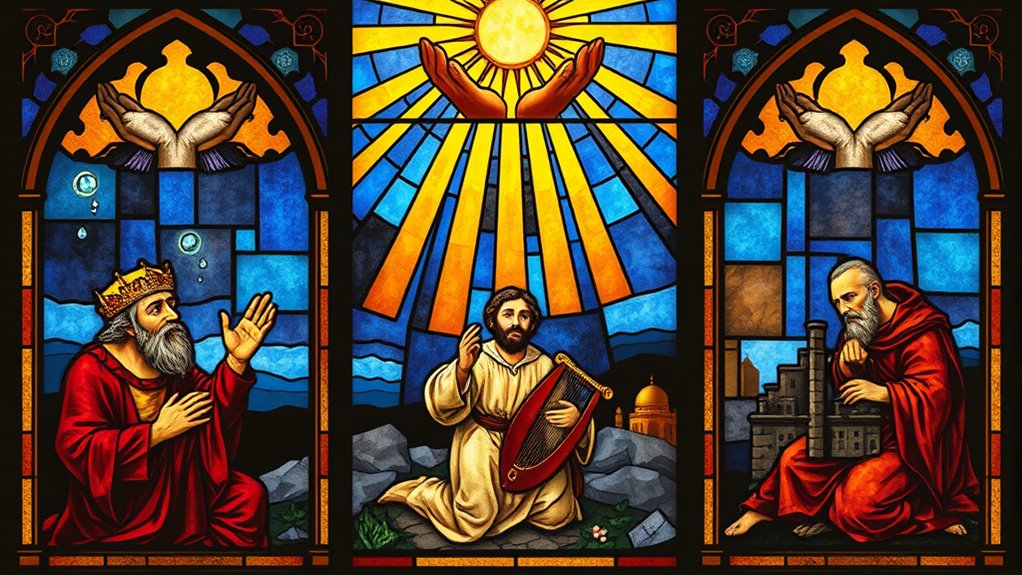





The Bible does not mention artificial intelligence directly, but it offers clear principles that apply. Genesis 1 presents humanity as made in God’s image, giving people a God-given capacity for creativity and making. Genesis 1:28 assigns humans responsibility to manage and develop creation, which scholars like Mark Ward Jr. connect to technology itself. Psalm 24:1 reminds believers that everything belongs to God, framing humans as stewards rather than owners. Those principles form a surprisingly complete guide for evaluating AI.
Key Takeaways
- The Bible doesn’t mention AI directly, but Genesis establishes humans as image-bearers of God with God-given capacity for creativity and innovation.
- Genesis 1:28 commissions humanity to steward and develop creation, providing a framework that extends to technological tools like AI.
- Scripture affirms technical skill and making as legitimate human activities, seen in the tabernacle and temple construction accounts.
- Psalm 24:1 reminds believers that God owns creation, positioning humans as managers responsible for overseeing tools like AI wisely.
- Human dignity rooted in imago Dei means AI must serve people, never replacing the wisdom and moral reasoning God gave humanity.
What the Bible Says About Technology, AI, and Human Creativity

From the opening chapters of Genesis, the Bible establishes a framework for understanding human creativity that extends naturally into questions about technology. Humanity, made in the image of God, inherits a capacity for making, shaping, and innovating.
Calvin University connects this directly to Genesis 1:28, often called the cultural mandate, where humans are charged with managing and developing creation. Scripture affirms technical skill throughout its pages, particularly in the construction of the tabernacle and temple. The Church’s long engagement with sacred texts has also produced many Catholic translations that inform contemporary theological reflection.
Theological commentary describes technology as “the creative ability of using tools to shape God’s creation for practical purposes.” ERLC notes that technology carries no moral agency of its own. That moral weight rests entirely with the humans who design, deploy, and direct it.
This creative capacity extends to information technology, which can be celebrated as part of God’s gift of creation, reflecting the same image-bearing creativity that drives all human making. Mark Ward Jr. argues that technology is not an accidental add-on in God’s world, but that its discovery and development arise directly from fulfilling the mandate to fill and subdue the earth.
Stewardship, Dignity, and Truth: The Biblical Framework for AI

When Scripture is brought into conversation with artificial intelligence, three interlocking principles emerge as central: stewardship, dignity, and truth.
Psalm 24:1 establishes that the earth belongs to God, placing humans in the role of managers rather than owners. This stewardship framework echoes biblical descriptions of humanity’s role in caring for creation and responsible oversight.
That framing shapes how AI should be approached—as a tool requiring responsible oversight, not autonomous moral authority.
AI is a tool demanding responsible human oversight—never an autonomous authority standing in for moral judgment.
Human dignity, rooted in the imago Dei, means people cannot be reduced to productivity units.
AI should strengthen human capacity, not replace human judgment in areas requiring wisdom and moral reasoning.
Truth adds a third layer.
Christian sources caution that AI outputs can appear credible while contradicting Scripture.
Faithful use so demands verification, accountability, and discernment—measuring technology not by convenience alone, but by whether it serves God’s glory and the common good.
Scholars such as Michael Heiser, Carmen Imes, and John Walton interpret the imago Dei as a purpose-driven designation, grounding human worth in God’s intentional design rather than in measurable traits or cognitive capacity.
Church AI adoption has grown substantially, with usage rising from 25 percent in 2024 to 45 percent in 2025 according to a Pushpay survey, signaling that faith communities are actively wrestling with how these tools fit within a biblical framework.
Practical Ways Christians Can Use AI Without Compromising Biblical Values

Principles like stewardship, dignity, and truth give Christians a foundation for evaluating AI—but they also point toward something practical: how those values translate into everyday choices about how the technology is actually used.
Church leaders can use AI to handle administrative work, freeing time for counseling, discipleship, and sermon preparation. Regular church attendance and small group participation remain essential for spiritual formation, so leaders should ensure AI enhances—not replaces—those community practices by supporting pastoral care and relational ministry.
Educators can build AI literacy into curriculum, teaching students to evaluate outputs rather than accept them without scrutiny.
Families can set boundaries in advance, use parental oversight, and choose faith-centered tools that incorporate Scripture and prayer.
In every setting, AI-generated content should be reviewed for theological accuracy before it reaches a congregation or classroom.
The consistent thread across all these uses is intentionality—treating AI as a tool that serves human calling rather than one that quietly replaces it. Most AI tools available today were built by secular companies for secular markets, meaning their default assumptions about truth, morality, and faith may not align with a biblical worldview.
Christians should also be aware that bias in AI systems can perpetuate social inequalities when the data and algorithms behind them reflect incomplete or unfair assumptions, making discernment an essential part of faithful engagement with these tools.