


The Bible contains no verse that explicitly forbids marriage or relationships based on race or skin color. Old Testament restrictions, such as Deuteronomy 7:3–4, targeted idolatry, not ethnicity. The New Testament emphasizes shared faith as the primary marriage standard, seen in passages like 2 Corinthians 6:14 and Galatians 3:28. Ruth, a Moabite, married Boaz and entered the messianic line of King David. Those seeking a fuller picture will find the details ahead clarifying.
Key Takeaways
- The Bible contains no verse explicitly prohibiting marriage or relationships based on race or skin color.
- Old Testament marriage restrictions targeted idol worship and spiritual unfaithfulness, not ethnic or racial differences.
- The New Testament emphasizes spiritual compatibility as the key marriage standard, warning against uniting with unbelievers, not other ethnicities.
- Ruth, a Moabitess, married Boaz, an Israelite, and their interethnic union was honored within the messianic lineage.
- When Miriam criticized Moses’ interracial marriage to a Cushite woman, God’s anger fell on the critics, not Moses.
Does the Bible Actually Forbid Interracial Relationships?
When people debate whether the Bible forbids interracial relationships, the answer found in Scripture itself is fairly clear. No verse explicitly bans marriage or dating based on race or skin color. The Old Testament includes restrictions, particularly in Deuteronomy 7:3–4, but the stated concern centers on religious loyalty, not ethnicity.
God warned Israel against marrying those who practiced foreign worship because it could draw the nation away from Him. Daily life in ancient Israel was conducted in multiple languages, including Aramaic, which shaped how communities interacted and understood religious instruction.
The New Testament maintains a similar position. Passages like 2 Corinthians 6:14 and 1 Corinthians 7:39 emphasize shared faith, not shared ancestry. Some scholars note that only one race exists in the biological sense, making the very term “interracial marriage” a misnomer rooted in social and cultural distinctions rather than Scripture.
Biblical scholars widely agree that the marriage restrictions found throughout Scripture are faith-centered rather than race-centered. Claims that the Bible bans interracial relationships rely on interpretation, not direct text. The so-called curse of Ham found in Genesis 9 is often cited as justification, yet the text itself ties the curse to dishonorable behavior, not race or marriage.
Why Old Testament Marriage Bans Targeted Idolatry, Not Ethnicity

Once it is established that Scripture contains no explicit ban on interracial relationships, a closer look at the Old Testament marriage restrictions reveals something specific: the laws were aimed at idolatry, not ancestry.
Deuteronomy 7:3–4 explains the prohibition plainly, warning that foreign spouses would turn Israel toward other gods.
Exodus 34:11–16 reinforces that concern by connecting forbidden marriages directly to idol worship.
The target was spiritual contamination, not bloodline.
Rahab was Canaanite, and Ruth was Moabite, yet both found belonging in Israel through covenant loyalty.
Scholars consistently note that ethnicity carried no independent weight in these passages.
What mattered was worship.
The laws identified nations by name because those nations practiced idolatry, making religious allegiance the actual dividing line throughout the Old Testament. Scholars such as Clauss argue that Israel’s identity was shaped not in a biologistic or ethnic-racist sense, but through a religious definition of holiness bound to exclusive devotion to YHWH.
This interpretation is further supported by the fact that Ezra–Nehemiah’s post-exilic marriage crisis, though often cited as evidence of ethnic exclusion, was evaluated by scholars against the Torah’s own examples of permitted foreign marriages involving women like Rahab and Ruth who embraced Israel’s God.
The concern for covenantal purity aligns with broader biblical theology that emphasizes the unity of God’s people under a single divine essence, as reflected in doctrines like the Doctrine of the Trinity.
What the New Testament Says About Interracial Marriage

The New covenant contains no passage that forbids marriage on the basis of race or ethnic background. The warnings it does offer focus on spiritual compatibility, particularly the danger of marrying someone outside the faith. The Catholic understanding of marriage also emphasizes the importance of shared faith and sacramental unity, which aligns with the New Testament’s focus on spiritual compatibility and sacramental marriage.
Paul’s instruction in 2 Corinthians 6:14 addresses spiritual union, not ethnic difference.
Galatians 3:28 further states that “Jew” and “Greek” carry no distinguishing rank before God.
Colossians 3:11 reinforces the same principle.
Acts 10:34–35 records God showing no partiality across peoples, and Ephesians 2:14–16 describes Christ removing the barrier between Jew and Gentile entirely.
The New Testament writers never used the modern concept of race.
Their consistent standard for marriage was shared faith.
Ethnicity simply never appeared as a standalone qualification or disqualification. Timothy, born to a Jewish mother and Greek father, stands as a living example of this reality within the New Testament itself.
When Miriam and Aaron criticized Moses for his marriage to a Cushite woman, God’s anger fell not on Moses but on the critics themselves, a striking testament to how seriously God regards contempt directed at interracial union.
Ruth, Boaz, and Biblical Couples Who Crossed Ethnic Lines
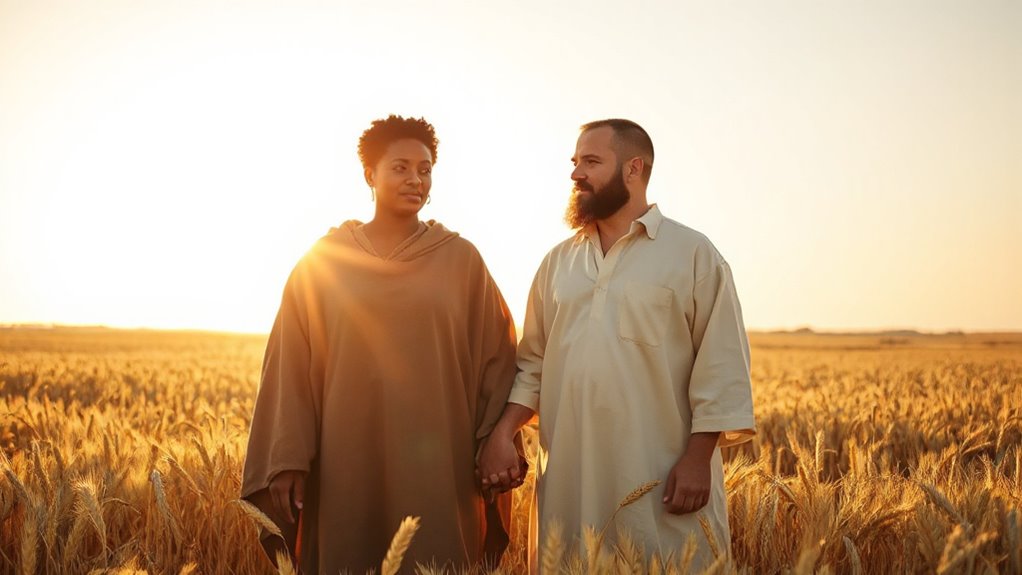
Among the clearest examples of an interethnic marriage in the Hebrew Bible is the union between Ruth, a Moabite woman, and Boaz, a Bethlehemite landowner from the tribe of Judah.
The book of Ruth identifies her Moabite background repeatedly, in chapters 1, 2, and 4, making her foreign identity central rather than incidental.
Ruth’s Moabite identity is named not once but repeatedly—making her foreignness a feature of the story, not a footnote.
Ruth migrates to Bethlehem with her mother-in-law Naomi and eventually marries Boaz, a relative of Naomi’s family.
The narrative presents the marriage positively, framing Ruth’s inclusion within Israel’s community as rooted in loyalty and covenant faithfulness.
Their son Obed became the grandfather of King David.
Matthew’s genealogy later includes Ruth, placing this interethnic union directly inside the messianic line and signaling its lasting theological significance beyond ethnic boundaries.
Deuteronomy explicitly barred Moabites from the Israelite community for up to ten generations, making Ruth’s full acceptance into Bethlehem and her marriage to Boaz a striking example of covenant responsibility extending beyond the letter of the law.
Boaz himself acknowledged that a closer relative existed with a prior right to redeem Naomi’s land and fulfill the role of guardian, yet that man declined, leaving Boaz to complete the redemption and marry Ruth.
The story is preserved in Hebrew and reflects ancient Near Eastern social and legal customs, including levirate-like practices and redeemer obligations that shaped family and property restoration.
Why Shared Faith, Not Shared Race, Is the Bible’s Marriage Standard

What the story of Ruth and Boaz makes plain is that ethnic background was not the determining factor in whether that marriage was treated as legitimate or blessed. The New covenant carries that same logic forward.
First Corinthians 7:39 states that a Christian widow may remarry, but “only in the Lord,” meaning shared faith sets the boundary, not shared ancestry.
Second Corinthians 6:14 warns against being “unequally yoked with unbelievers,” a passage theologians at Desiring God identify as addressing spiritual compatibility in covenant relationships.
First Corinthians 7:12–16 further distinguishes believers from unbelievers without referencing ethnicity at all. Golgotha was located outside Jerusalem’s ancient city walls, a placement that highlights how important location and separation were in ancient covenant and sacrificial practices, and archaeological evidence links this site to the Church of the Holy Sepulchre and early Christian tradition about Golgotha.
Across these texts, the consistent standard is loyalty to God and union with a fellow believer. Race simply does not appear as a qualifying criterion. First Corinthians 7:14 also affirms that an unbelieving spouse is “sanctified” through the believing one, a statement that assumes cross-belief marriages can exist while still centering faith as the defining relational boundary.
First Corinthians 7:15 adds that if an unbelieving partner chooses to separate, the believer is not enslaved in such circumstances, a provision that underscores how seriously the Bible treats the spiritual dynamic between believing and unbelieving spouses.