
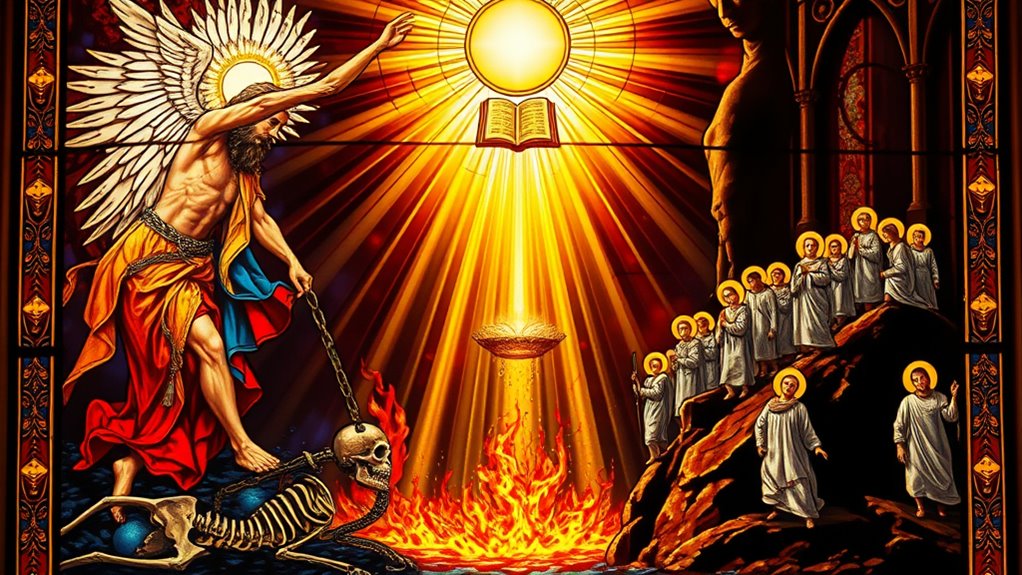
The Bible describes death as a sleep-like state, not a permanent end. Ecclesiastes 9:5 notes that the dead are unaware, while John 11:11 records Jesus calling death a sleep before raising Lazarus. Scripture consistently points toward resurrection as the ultimate answer, promising that believers will one day be awakened. Those who explore the topic further will find a detailed picture of what the Bible says awaits the dead.
Key Takeaways
- The Bible compares death to sleep over fifty times, portraying the dead as unconscious and unaware until resurrection.
- At death, believers enter paradise in conscious fellowship with Christ, while unbelievers enter a place of conscious torment.
- Believers’ souls immediately join Christ after death, while their bodies remain in the grave awaiting resurrection.
- Both the righteous and unrighteous will be physically resurrected, making death a temporary rather than permanent condition.
- Death itself will ultimately be destroyed, thrown into the lake of fire, ending its existence forever.
What Happens to the Dead According to the Bible?

According to the Bible, the fate of a person’s soul is determined the moment death occurs. Scripture describes two immediate destinations, each reflecting a person’s relationship with God during their lifetime.
The soul’s eternal destination is sealed at death, shaped entirely by one’s relationship with God in life.
Believers, whose sins are forgiven through Christ, are received into paradise, a domain of comfort sometimes called Abraham’s side. Unbelievers are sent to a separate sphere of conscious torment, described as a fiery place of anguish.
A fixed chasm divides the two, and movement between them is impossible. Both destinations are temporary, functioning as waiting places within Sheol, the biblical term for the world of the dead.
Souls remain conscious in these states, thinking, feeling, and communicating, until the final resurrection and judgment that follows Christ’s return. The saved will ultimately dwell in the new heavens and earth, the permanent eternal home that follows the intermediate state and final judgment.
At the resurrection, the physical body is raised, glorified, and reunited with the soul before entering into its final eternal existence.
Why Does the Bible Compare Death to Sleep?
Throughout the Bible, death is compared to sleep fifty-four times across both the Old and New covenants, making it one of Scripture’s most consistently used metaphors for the condition of the dead.
The comparison carries several clear reasons. Like sleep, death involves an unconscious state — no thought, awareness, or brain activity, as Ecclesiastes 9:5 and Psalm 146:4 confirm.
Like sleep, it is temporary. Daniel 12:2 describes the dead as those who “sleep in the dust of the earth” and shall awake at resurrection.
Jesus himself applied the metaphor directly in John 11:11–14, equating Lazarus’s death with sleep before raising him. Paul reinforced this in 1 Thessalonians 4:13–14, offering comfort rooted not in denial of death, but in the certainty of resurrection.
This understanding was not a fringe position in early Christianity — prevailing opinion held that the dead sleep in this unconscious state until the resurrection, a view that persisted widely until as late as the fifth century.
The very word “cemetery” traces back to the Greek koimeterion, derived from koimao, a word meaning sleep — a linguistic echo of the same biblical truth that the dead rest and await resurrection.
Where Do Believers Go Between Death and Resurrection?

Bridging the gap between a believer’s death and the future resurrection is one of Scripture’s more carefully detailed teachings, often called the intermediate state. According to 2 Corinthians 5:6-8, the soul moves immediately into Christ’s presence upon death, described as being “away from the body and at home with the Lord.” The physical body remains in the grave while the soul resides in a temporary heaven, consciously aware and spiritually present with Christ.
Paul reinforced this in Philippians 1:23, expressing genuine preference for departing to be with Christ. This separation of soul and body continues until Christ’s return, when 1 Thessalonians 4:16 and 1 Corinthians 15:52 describe a trumpet signal marking the resurrection. Eastern Orthodox, Roman Catholic, and most Protestant traditions consistently affirm this two-phase understanding. At the resurrection, believers will receive imperishable and glorious bodies, as promised in 1 Corinthians 15, marking the complete fulfillment of salvation for the whole person.
Some hold an alternative view known as soul sleep, in which the soul remains unconscious until the Day of Resurrection at the end of the age, drawing on passages such as 1 Thessalonians 4:13-14 as interpretive support.
What Does the Bible Promise About the Resurrection?
While the intermediate state addresses where the soul resides between death and resurrection, Scripture moves further to describe what resurrection itself will actually accomplish.
The Bible’s promises are specific. John 3:36 links resurrection to eternal life for those who believe in Jesus. Romans describes freedom from sin’s power through union with Christ. Revelation 21:5 points toward a complete renewal of all things, heaven and earth joined together. Acts 24:15 confirms that both the righteous and unrighteous will be raised, meaning resurrection carries consequences beyond simple restoration. For believers, 1 Thessalonians 4:14 adds that those who died trusting Jesus will be brought with him. Taken together, these promises frame resurrection not merely as resuscitation, but as the fulfillment of everything God originally intended for humanity.
Isaiah 25:8 declares that God will swallow up death forever, a promise Paul directly echoes in 1 Corinthians 15:54 when describing the moment the perishable puts on the imperishable.
The Bible records nine confirmed resurrections with eyewitnesses, including notably the resurrection of Lazarus after four days in the tomb, performed before a crowd whose testimony his opponents could not deny.
What Does the Bible Say Will Happen to Death in the End?

The Bible does not treat death as a permanent feature of existence. According to Revelation 20:14, death itself is eventually thrown into the lake of fire, along with Hades, the temporary sphere where the dead wait. This act effectively ends both as ongoing realities.
Temporary holding places serve their purpose only until the final judgment concludes. After that, the Book of Revelation describes a new heavens and a new earth, detailed in Revelation 21:1, where believers enter an existence without death.
The lake of fire serves as the eternal counterpart for those outside the Book of Life. In this framework, death functions as a transitional condition rather than a permanent state, ultimately abolished when the current order gives way to the new creation.