




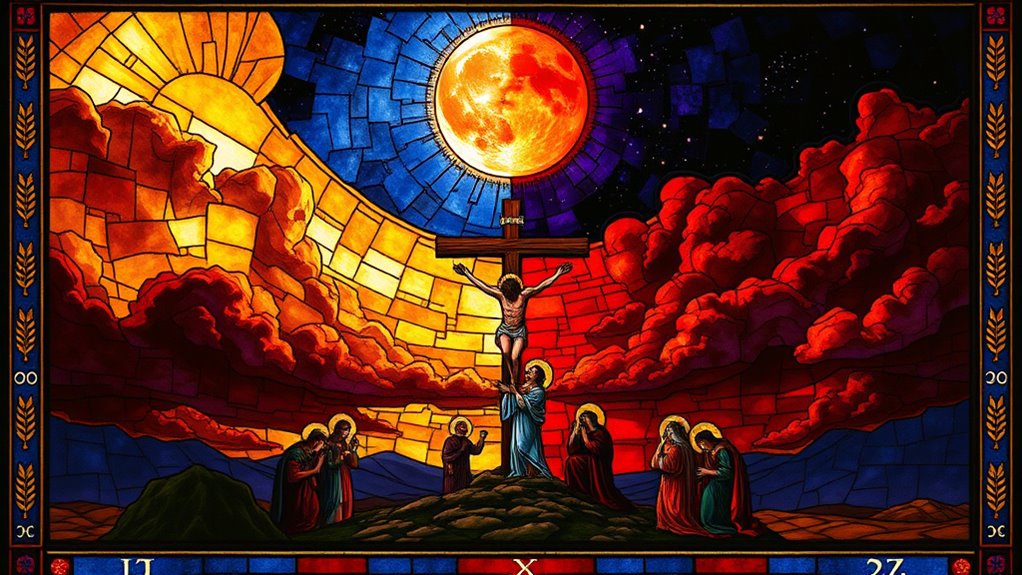
Most historians place the crucifixion of Jesus between AD 30 and AD 33, with April 3, AD 33 drawing the strongest support. Astronomers confirm Nisan 14 fell on a Friday that year. NASA records document a lunar eclipse visible in Jerusalem that evening. Geological data from Dead Sea sediment layers independently points to the same year. No single piece of evidence settles the question alone, but the full picture rewards closer examination.
Why the Crucifixion Date Still Matters to Historians
For nearly two thousand years, scholars have debated the precise date of Jesus Christ’s crucifixion, and that debate remains genuinely consequential. Determining when Jesus died connects Christianity to verifiable historical events rather than purely subjective religious experience. Named figures such as Pontius Pilate, Caiaphas, and Herod Agrippa I provide chronological markers that historians can cross-reference against Roman administrative records and Jewish documentation. Multiple independent methodologies—astronomical, textual, and chronological—converge on narrow possibilities. Protestant, Catholic, and secular scholars alike recognize that establishing an accurate date strengthens academic credibility while also resolving apparent discrepancies between the gospel accounts regarding Passover timing. John’s Gospel records attendance at three distinct Passovers during Jesus’s public ministry, providing a structural framework that anchors the length of his ministry and points scholars toward a specific crucifixion year. A clear understanding of Israel’s covenantal promises and land-centered history in the biblical narrative helps contextualize the political and religious tensions that framed Jesus’s life and death. A landmark survey by Blinzler in 1969 found that more than half of scholars examined favored AD 30 as the crucifixion year, with fifty-three out of one hundred preferring it over competing dates such as AD 33, AD 29, or others.
How Scholars Actually Narrow Down the Crucifixion Date
Establishing why the crucifixion date matters is one thing; explaining how scholars actually pin it down is another. Researchers cross-reference four main sources: biblical texts, Roman and Jewish historical records, astronomical data, and prophetic timelines.
Astronomers Colin Humphreys and Graeme Waddington identified only four viable years, AD 27, 30, 33, and 34, when Passover fell on a Friday. Daniel’s prophecy, counting 483 years from Artaxerxes’ decree, points toward AD 33. Tiberius’ reign helps anchor John the Baptist’s ministry around AD 28. Each line of evidence narrows the field, though no single source settles the question alone. A geological search of NOAA/NGDC records for the years AD 25–35 yields a notable earthquake in the Israel region specifically in AD 33, lending additional support to that date. The broader biblical context, which treats Israel as chosen with prophetic visions tied to covenant history, provides interpretive background scholars use when weighing these data.
The Case for AD 30 and Why It Falls Short
Many scholars have found AD 30 an appealing candidate for the crucifixion year, and the case rests on a reasonable foundation.
- Phlegon recorded a solar darkness in Tiberius’s eighteenth year, matching AD 30
- Friday, Nisan 14 aligns with April 5, AD 30 on the Hebrew solar calendar
- Pontius Pilate’s governorship from AD 26–36 comfortably fits this date
However, the timeline requires accepting Tiberius’s reign beginning in AD 11, during his joint rule with Augustus, rather than his sole rule starting AD 14. Critics consider this adjustment selective.
The evidence remains genuinely compelling but not universally settled. Historians such as Thallus, Africanus, and Tertullian also documented the darkness and earthquake effects associated with the crucifixion period, lending additional ancient witness to the AD 30 framework. Luke’s account further anchors the broader chronology by dating the beginning of John the Baptist’s ministry to the fifteenth year of Tiberius, placing the earliest possible date for the crucifixion after AD 29. Theological themes like incarnation and salvation in the New Testament provide the broader religious context that makes these chronological discussions significant.
Why the Evidence Points to AD 33, Not AD 30
While AD 30 carries genuine appeal, the cumulative weight of chronological, astronomical, and geological evidence tilts noticeably toward AD 33. Tiberius Caesar’s fifteenth regnal year places John the Baptist’s ministry beginning in AD 28, pushing Jesus’ ministry start to AD 29. A full three-year ministry then lands precisely on AD 33.
Astronomically, Nisan 14 fell on a Friday that year, confirmed by scholar Harold Hoehner. NASA records document a partial lunar eclipse visible in Jerusalem on April 3, AD 33. Geologist Jefferson Williams separately identified earthquake sediment layers in the Dead Sea matching that same date, corroborating Matthew’s crucifixion account independently. Williams and his colleagues offered three interpretive possibilities for the seismic disturbance, including a direct correspondence to Matthew’s earthquake, a borrowed report, or a local quake with no surviving extra-biblical record.
The Gospel of John records Jesus attending three or four annual Passovers during his ministry, and AD 33 accommodates these Passovers far more naturally than AD 30, which would compress the entire ministry into an uncomfortably narrow window of one to two years. The broader pattern also aligns with biblical emphases on prophetic fulfillment and eschatological themes like judgment and renewal.
What Astronomy, Scripture, and History Agree On
Across three separate fields of inquiry, the evidence for April 3, AD 33 as the crucifixion date converges with unusual consistency. NASA-confirmed lunar eclipse data, Gospel accounts, and independent historians align around the same Friday in spring. The biblical descriptions reflect an ancient cosmological language that spoke of a divided sky or firmament separating waters above and below.
Three disciplines. One date. Astronomy, scripture, and history converge on April 3, AD 33 with striking consistency.
- NASA records a lunar eclipse visible from Jerusalem on April 3, 33 CE
- Gospel accounts describe darkness from noon to 3 PM on Passover preparation day
- Scholars Humphreys, Schaefer, and Pratt independently reached identical conclusions
No single strand proves the date alone. Together, however, astronomy, scripture, and history point toward the same moment with a clarity that researchers across disciplines find difficult to dismiss. Pontius Pilate governed Judea from AD 26 to AD 36, and his removal in AD 36 establishes a firm upper boundary that, combined with political pressures following AD 31, places the crucifixion squarely within the AD 33 window. A solar eclipse explanation for the Gospel darkness accounts is ruled out by Passover’s full moon, since solar eclipses can only occur at new moon, reinforcing that any astronomical event at the crucifixion must be sought elsewhere.