When the Pope addresses global audiences, he speaks primarily as a pastor for more than a billion Catholics, not as a political leader. His sovereign title governs Vatican City, a 44-hectare state established by the 1929 Lateran Pacts, but Catholic teaching places shepherding above statecraft. His recurring messages on war, migration, and human dignity reflect that pastoral identity. There is considerably more to understand about how that distinction shapes his voice.
The Pope’s Dual Identity: Shepherd and Sovereign
At the center of Catholic life stands a figure who holds two distinct titles at once: chief pastor of the world’s largest Christian church and sovereign of the world’s smallest state.
One figure, two titles: shepherd of the world’s largest church and sovereign of its smallest state.
Vatican City covers less than half a square kilometer inside Rome, yet its sovereign status grants the Holy See independence from any other nation.
Catholic teaching places the shepherd role above the sovereign one.
The arrangement is described as instrumental, meaning temporal authority exists primarily to protect spiritual freedom.
Pastor first, head of state second — that ordering, according to Catholic thought, defines the office’s true purpose. The servant leadership model in Scripture undergirds this priority, emphasizing pastoral service over political power. The Lateran Pacts of 1929 established this framework, resolving longstanding questions about the Pope’s sovereign status and territorial independence.
As shepherd, the pope speaks to the whole world and to each individual, offering encouragement, correction, and spiritual presence that reflects Christ rather than the interests of any earthly government.
What the Lateran Pacts Created for the Pope
The shepherd-and-sovereign arrangement described above did not emerge from ancient tradition. It was formally created on February 11, 1929, through the Lateran Pacts between Italy and the Holy See.
The agreement established Vatican City as an independent state of roughly 44 hectares, resolving nearly sixty years of conflict following Italy’s capture of Rome in 1870. Italy recognized full papal sovereignty, and a separate financial convention compensated the Church with approximately 1.75 billion lire. The arrangement also reflected broader Biblical themes about leaders’ distinct roles and responsibilities, emphasizing accountability to God in governance.
The pope gained a recognized territorial base, freeing him from dependence on Italian civil authority while retaining the standing needed to lead the Church internationally. The pacts were signed by Cardinal Pietro Gasparri on behalf of Pope Pius XI and by Mussolini on behalf of King Victor Emmanuel III.
The treaty also carried structural consequences for the Church’s presence in Italian public life, including a provision under which bishops swore loyalty to the Italian state and were required to be Italian subjects who spoke the Italian language.
The Pope’s Voice on War, Migration, and Human Affairs
Together, their appeals reflect three recurring concerns:
- Immediate ceasefires and civilian protection
- Humanitarian aid reaching those displaced by conflict
- Treating refugees as persons with dignity, not statistics
Both popes have framed migration as driven by war, injustice, and climate, not personal choice. Pope Leo XIV has called migrants and refugees “messengers of hope”, describing their presence as a divine blessing capable of revitalizing communities darkened by conflict and suffering.
In his first address to Congress in 2015, Pope Francis described a refugee crisis of a magnitude not seen since the Second World War, urging lawmakers to see displaced persons not as abstract numbers but as individuals with faces and stories deserving of humane and just responses. The popes’ teachings also echo biblical calls to care for the poor and protect the vulnerable, which provide moral guidance for public policy and civic engagement.
What Makes the Pope’s Voice Different From a Politician’s
When popes speak about war, migration, or human dignity, the words carry a different kind of weight than those spoken by a president or a prime minister.
A politician seeks votes, builds coalitions, and answers to an electorate.
The pope holds no electoral mandate.
His authority comes from religious office and centuries of Church teaching.
Aleteia notes that popes do not arrive as policy technicians with blueprints.
Instead, they speak in moral terms, emphasizing human dignity, solidarity, and the common good.
The goal is conscience formation, not campaign persuasion, making papal speech something distinct from ordinary political communication.
This tradition stretches back through history, with figures such as Leo XIII addressing the upheavals of industrialization and John Paul II speaking out against totalitarian regimes.
Pope Leo XIV has carried this pastoral voice into public gatherings, including a recent meeting with young people at the Go! Franciscan Youth Meeting in Assisi.
The Bible’s teaching that governing authorities are legitimate but subservient to ultimate allegiance to God underpins why papal interventions focus on moral witness rather than partisan politics.
Why Catholics Hear the Shepherd, Not the Head of State
For Catholics, the pope’s words carry a particular kind of authority that has little to do with Vatican City’s status as a sovereign state.
Three images help explain why:
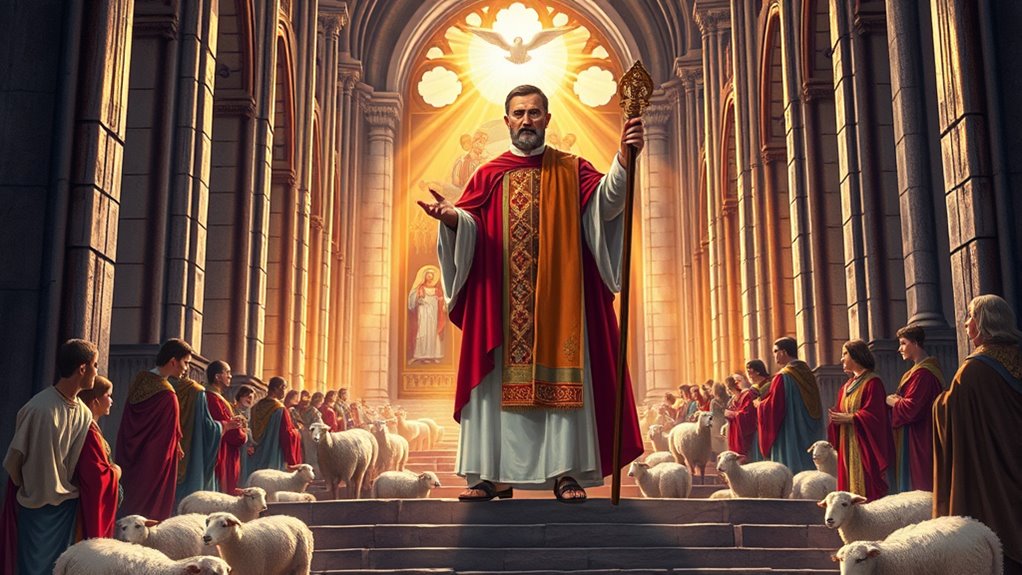
- A shepherd calling his flock, not a diplomat negotiating borders
- A teacher speaking from the Gospel, not a legislator drafting policy
- A pastor tending souls, not a sovereign managing territory
Vatican sources describe the faithful as people trained to listen for the shepherd’s voice.
Tornielli’s Vatican News piece confirms the pope’s “one true mission” is universal Shepherd, making that the primary lens Catholics use when hearing him speak. Communal worship also shapes how Catholics receive his teaching, emphasizing formation within the gathered Church.
Catholic tradition holds that this shepherding authority traces back to Saint Peter, whom Jesus named as the foundation upon which the Church would be built.
Pope Leo XIV himself reinforced this distinction when addressing members of the Spanish Parliament, identifying himself as the bishop of Rome and shepherd of the Catholic Church rather than as a head of state.