


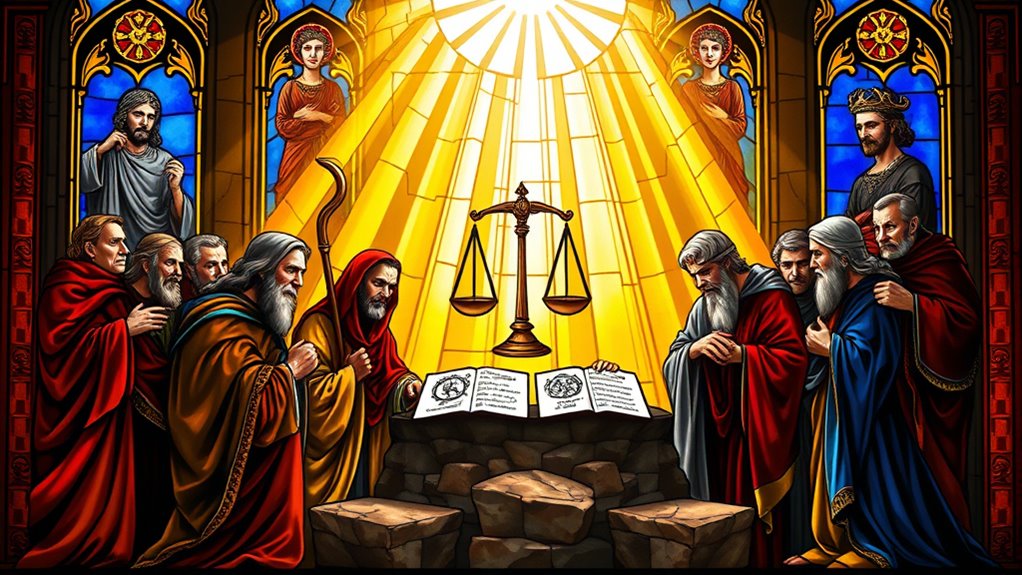



The Bible treats killing in war as a distinct moral category from murder. Exodus 20:13 uses the Hebrew word *ratzach*, meaning unlawful, intentional killing, while *harag* covers broader contexts including war. Old Testament law in Deuteronomy 20 and Numbers 31 presents divinely authorized military action without applying murder prohibitions. The New Testament complicates this with Jesus emphasizing peacemaking and enemy-love. Those distinctions carry significant implications worth exploring further.
Key Takeaways
- The Hebrew word *ratzach* in Exodus 20:13 refers to unlawful killing, not wartime killing, making murder and war distinct categories.
- Deuteronomy 20 provides legal frameworks for war, including peace offers and conduct rules, suggesting regulated warfare was biblically accepted.
- Numbers 31 describes God explicitly commanding Israel to fight, presenting wartime killing as divinely authorized without applying murder prohibitions.
- Romans 13:4 states rulers “do not bear the sword in vain,” granting governing authorities legitimate use of force for justice.
- Jesus’s Sermon on the Mount teachings on peacemaking and enemy-love create genuine tension, leaving Christian war ethics unsettled rather than resolved.
Does the Bible Distinguish Murder From Killing in War?

One of the most debated questions in biblical ethics is whether the Bible treats killing in war differently from murder.
Many scholars argue that it does, pointing to the Hebrew vocabulary in Exodus 20:13.
The commandment uses the word *ratzach*, which refers specifically to unlawful, intentional killing rather than every form of taking life.
A broader term, *harag*, covers killing in war and other contexts.
This word-level distinction appears consistently in biblical commentaries and shapes how theologians approach warfare ethics.
Killing under legitimate authority, for a just cause, is generally not placed in the same moral category as murder.
Killing under lawful authority, in pursuit of a just cause, has rarely been equated with murder.
Numbers 31 reinforces this pattern, describing wartime killing without applying the same condemnation found in prohibitions against unlawful homicide. Numbers 35:16-24 further draws a legal boundary between justified wartime acts and murder under Old Testament law.
In Numbers 31, the Israelites were explicitly commanded by God to fight, and 12,000 armed men were sent into battle against the Midianites as an act of divinely authorized war.
Scholars often date these narratives to the late first millennium BC, a timeframe that aligns with broader historical analysis of ancient Israelite warfare and biblical chronology.
What Does the Old Testament Actually Say About War?

Throughout the Old covenant, war appears not as a rare exception but as a recurring feature of Israel’s national story. The Hebrew word *milchamah*, meaning war or battle, appears in hundreds of passages spanning the Torah, Former Prophets, and Writings. Regular reading plans and repeated readings can help reveal patterns and themes across these texts.
Key narratives include Egypt’s pursuit of Israel, the conquest of Canaan, the judges period, and David’s military campaigns.
Deuteronomy 20 provides the clearest legal framework, requiring peace offers before attacking cities outside Canaan, exempting certain soldiers from service, and prohibiting the cutting down of fruit trees during sieges.
Some wars are presented as divine judgment, particularly the Canaanite conquest.
Prophetic books later criticized unchecked military power.
Before troops engaged the enemy, priests addressed soldiers to deliver a message of courage, reminding them that God would go with them into battle and fight on their behalf.
Soldiers with specific unfinished life circumstances, such as a new house, an unenjoyed vineyard, or a betrothed but unwed wife, were permitted to return home before battle began.
What Jesus and the New Testament Teach About Violence and Peace

When the Gospel turns to questions of violence and peace, the teaching of Jesus stands at the center of the conversation. In Matthew 5:39, Jesus instructs followers not to resist an evil person, offering the well-known “turn the other cheek” example alongside commands to give generously and go the extra mile. He likely delivered these teachings in Aramaic, the everyday language of first-century Palestine.
Scholars generally read this as guidance on personal conduct rather than state policy. The Sermon on the Mount also blesses peacemakers and calls for love toward enemies.
Scholars largely treat these teachings as personal ethics, not blueprints for state policy or national governance.
During his arrest in Matthew 26, Jesus commands a disciple to put away the sword. Letters like Romans 12 and 1 Peter reinforce a pattern of patient, nonretaliatory witness.
Debate continues, however, over whether these teachings extend directly to questions of warfare and national defense. Romans 13 establishes that the state bears a distinct responsibility to resist evil and execute justice, a role described in terms of wielding the sword.
The “extra mile” command in Matthew 5 reflects the reality that under Roman rule a private citizen in Judah could be conscripted to carry a soldier’s pack, with Roman law capping the obligation at one mile.
What Does Romans 13 Say About War and Government Authority?
Romans 13 occupies a central place in Christian thinking about government, law, and the use of force. The passage describes governing authorities as instituted by God, with rulers serving as God’s servants for maintaining order and punishing wrongdoing.
Romans 13:4 specifically notes that the ruler “does not bear the sword in vain,” a phrase widely interpreted as granting the state legitimate authority to use coercive force. Catholics and many other Christians have historically read this in light of doctrines about rightful authority and the state’s role in maintaining justice, including the use of force when necessary state authority.
Many interpreters extend this logic to include warfare, arguing that defending justice and public order falls within the state’s God-given mandate. Others limit the passage to domestic civil authority, stopping short of treating it as a direct endorsement of military action.
Most agree, however, that Romans 13 does not grant unlimited power, binding obedience only within the boundaries of lawful, God-accountable governance. Theologians such as Nicholas Wolterstorff argue that state authority is delegated authority, meaning obedience is conditional on the state acting within what God has actually authorized.
Faithful interpretation of Romans 13 requires reading it alongside texts such as Acts 5:29 and Revelation 13, which together demonstrate that unyielding refusal is warranted when the state oversteps its God-given boundaries and demands what belongs to God alone.
Does the Bible Ever Justify Killing in War?

One of the central questions in biblical ethics is whether the Bible ever presents killing in war as morally justified, and the short answer most scholars offer is: sometimes, under specific conditions.
The Old Testament records episodes where God commands Israel to fight specific battles, often framed as divine judgment against hostile nations. Archaeological findings and historian Josephus help situate these narratives within a chiefly Jewish environment and historical context first-century Palestine.
Scholars generally treat these as cases tied to particular covenant conditions rather than open permission for all violence.
The Sixth Commandment’s prohibition on murder, most theologians explain, targets unlawful killing, not every act of taking life.
Wartime killing under recognized authority occupies a separate moral category in most biblical analysis.
Still, the New Testament complicates easy approval, emphasizing peacemaking and enemy-love, which keeps Christian thinking on war genuinely divided rather than settled. When soldiers asked John the Baptist for guidance, his response addressed conduct, not occupation, suggesting soldiering itself was not condemned.