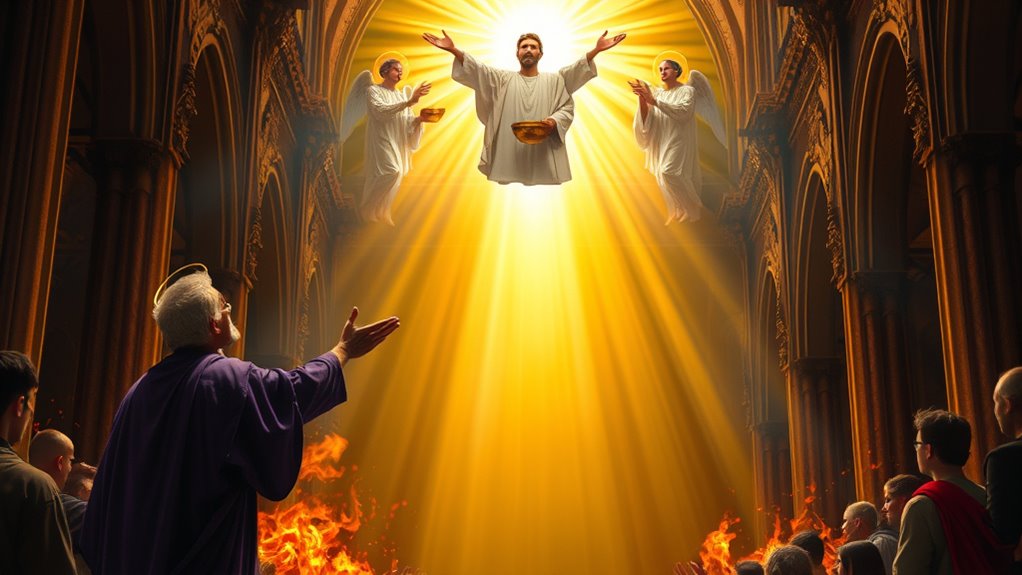








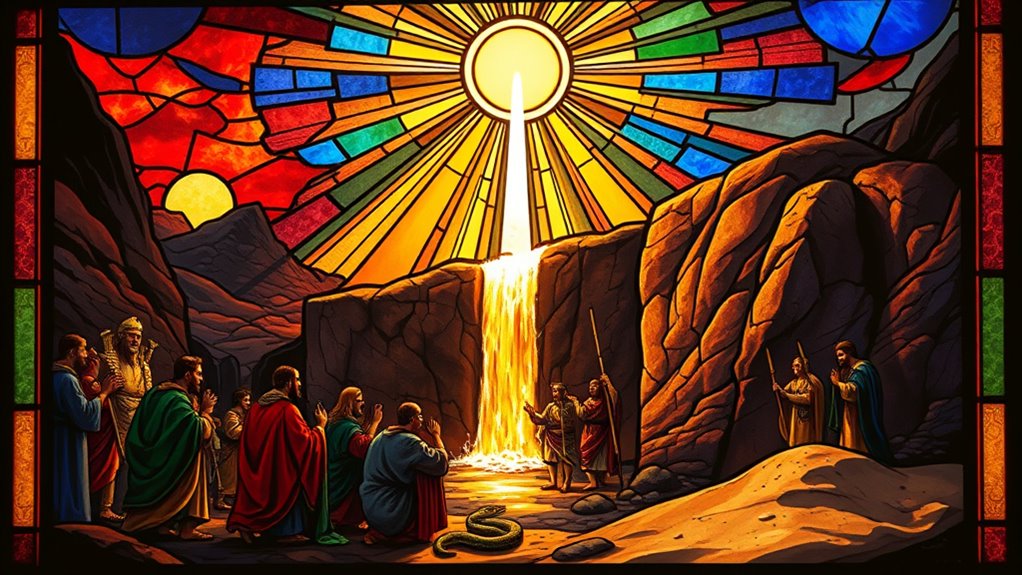
In 1 Corinthians 10:4, Paul identifies the wilderness rock that sustained Israel as Christ, drawing on water-from-rock episodes in Exodus 17 and Numbers 20. His claim extends further into Deuteronomy 32, where God is repeatedly called “the Rock,” connecting provision, covenant faithfulness, and warnings against idolatry. Whether Paul intended a literal moving rock or a typological symbol remains debated among scholars. The full picture of what Paul meant for the Corinthians becomes clearer further on.
What Paul Actually Says in 1 Corinthians 10:4
The verse appears within a broader warning section, where Paul uses Israel’s wilderness history to caution the Corinthians against presumption. Paul presents Christ as the true source behind Israel’s sustaining drink, linking sacred history to Christian experience through one compressed, deliberate statement.
The wilderness account draws on episodes at both Horeb and Kadesh, where water was miraculously produced from rock. Exodus 17 and Numbers 20 stand behind Paul’s reference, providing the narrative foundation from which he draws his christological identification.
The label “spiritual” applied to both food and drink points not to the absence of physical reality but to the divine origin of the provision, with God supplying each miracle directly. Psalm 105:41 captures the same memory, noting that the rock opened and water gushed out and flowed like a river in the desert. Contemporary readers can consider how biblical teachings on covenantal provision and marriage and sex inform interpretation and pastoral application.
The Two Rock-and-Water Stories Behind Paul’s Claim
Paul’s claim in 1 Corinthians 10:4 rests on two distinct stories from Israel’s wilderness period, both involving water produced from a rock, yet separated by geography, circumstance, and outcome.
The first appears in Exodus 17, where Moses strikes a rock at Rephidim once, following God’s instructions, with elders present as witnesses.
The second appears in Numbers 20, set in the wilderness of Zin, where God instructs Moses to speak to the rock. Moses instead strikes it twice and faces judgment.
These two episodes, different in location, required action, and moral outcome, form the textual foundation underlying Paul’s compressed reference. Israel reached Rephidim only after moving through Dophkah and Alush, each stage occurring under commandment of the Lord.
At Rephidim, the provision of water from the rock was inseparable from God’s presence, as the Lord promised to stand there before the rock while Moses struck it. The episodes also point forward theologically to the hope of resurrection and eternal life offered through Christ.
Why Paul Reaches Back to Deuteronomy 32
When Paul identifies the wilderness rock with Christ in 1 Corinthians 10:4, he is drawing on a scriptural tradition that extends well beyond Exodus and Numbers. Deuteronomy 32 provides the clearest foundation for that move.
Four reasons explain Paul’s use of Deuteronomy 32:
Four reasons explain Paul’s use of Deuteronomy 32 in his identification of the wilderness rock with Christ.
- It repeatedly calls God “the Rock,” supplying direct biblical vocabulary.
- It connects the Rock with covenant faithfulness, judgment, and provision.
- It addresses apostasy and idolatry, matching Paul’s concern in 1 Corinthians 10.
- It reinforces continuity between Israel’s God and Christ, avoiding any suggestion of a separate divine figure.
The Hebrew word “Tzur,” used exclusively of God throughout the song, carries a weight that no mere metaphor could bear, as no man is ever described by this term in the Old Testament.
Paul, a recognized expert in Old Testament Scriptures, almost certainly had these Deuteronomy 32 references in mind when he applied the term “Rock” directly to Jesus Christ.
This reading aligns with the Bible’s presentation of Scripture as authoritative and inspired, intended for teaching, correction, guidance, and spiritual transformation.
Did Paul Mean a Literal Rock or a Symbol?
Having established why Paul reaches back to Deuteronomy 32, the next question is what exactly he meant when he called the wilderness rock “spiritual” and said it followed Israel.
Most commentators favor a typological reading: the rock points forward to Christ rather than describing a stone rolling through the desert.
In this view, the water remains literal, the rock remains geological, and Christ becomes the fulfillment behind both.
Some interpreters go further, identifying the rock with Christ’s real presence in Israel’s history. Jewish rabbinic tradition described the rock as taking the form of a beehive, rolling along with Israel throughout the entire wilderness journey.
Either way, the dominant conclusion is symbolic and typological, not a claim about moving geology.
At no point does the Pentateuch narrative indicate that a literal stone followed Israel, since the text presents multiple water sources across the forty-year wilderness period rather than a single mobile rock.
This typological interpretation also aligns with New Testament themes emphasizing spiritual fulfillment over physical signs.
What Paul Was Really Telling the Corinthians
The rock passage in 1 Corinthians 10 was never meant to settle questions about moving geology or mystical presence in the abstract. Paul was addressing a practical problem in Corinth: overconfidence. This concern echoes broader biblical themes about rulers and responsibility, reminding readers that leadership and followers alike are accountable to God.
His warning carried four specific points:
- Israel received real spiritual privileges yet still fell under judgment
- Religious rituals do not guarantee protection from moral collapse
- Participation in pagan meals creates genuine divided loyalty
- Vigilance, not presumption, marks faithful covenant living
Paul used Israel’s story as a mirror. The Corinthians were meant to see themselves and respond with humility rather than confidence in spiritual status alone. God promises a way out so that his people are never crushed by temptation beyond what they can bear.
The wilderness generation shared in the same spiritual food and drink, yet their participation in those gifts did not shield them from the consequences of idolatry, sexual immorality, and grumbling.