

Catholic teaching holds that every person has a guardian angel, and many theologians say this includes the unbaptized. Scripture never states it outright. Passages such as Psalm 91:11 and Matthew 18:10 suggest angelic protection, yet they allow more than one reading. Orthodox Christians affirm a personal angel, while Protestants, following Calvin’s caution, tend to pray to God alone. Further sections explain where each tradition draws its lines and why.
Does Everyone Have a Guardian Angel?
Many Christians believe that a guardian angel watches over each person, but the answer to whether everyone has one depends on which tradition is asked.
Catholic teaching is the most direct, holding that every baptized person has a guardian angel, and many Catholic sources extend that care to every human being. Marilyn Santos explains that the Catholic belief is that everyone, including non-Christians, has an angel assigned to them for their time on Earth.
Some theologians place the assignment at birth, others at conception, though the Church has not settled every detail. The Catechism of the Catholic Church (No. 336) states that human life is surrounded by the “watchful care and intercession” of angels from its beginning until death.
Many Protestant writers note that Scripture shows angels protecting people but does not clearly assign one to each individual.
Still, surveys show broad American belief, which offers many people comfort. Angels are described in the Bible as created spiritual beings who serve God in roles like protecting and ministering to people.
Which Bible Verses Point to Guardian Angels?
Which passages of Scripture do believers turn to when they talk about guardian angels? Most point first to Psalm 91:11, which says God “will command his angels concerning you to guard you in all your ways.” Verse 12 adds that angels will lift the protected person, preventing injury. Verse 13 extends this imagery of authority, saying the protected person will tread on the lion and cobra. Psalm 34:7 describes the angel of the Lord encamping around those who fear him, an image of surrounding protection. The same psalm that promises angelic care in Psalm 91 also ties it to those who make Jehovah their refuge and habitation. Exodus 23:20 presents an angel sent to protect travelers along the way. Luke 4:10 quotes Psalm 91 during the temptation of Jesus, showing its early prominence. None uses the phrase “guardian angel.” Many readers connect these texts with a biblical sense of confident expectation about God’s protecting care.
Where Does Scripture Stop Short on Guardian Angels?
Scripture says a good deal about angelic protection, but it says far less about guardian angels as a formal doctrine. The phrase “guardian angel” never appears, and no passage states that every person receives one assigned angel. Even Herman Bavinck disputes the idea that every elect person is assigned an angel, tracing the notion to the book of Tobit. Matthew 18:10, Acts 12:15, Hebrews 1:14, and Psalm 91:11 are suggestive, yet each allows more than one reading. Jesus’ wording in Matthew 18:10 refers to “their angels” in connection with children, but the passage stops short of explaining whether this means personal guardian angels or a broader angelic care. The text does not say when an angel is assigned, whether one angel serves one person, or how long that care lasts. Still, Scripture presents God as the ultimate protector, with angels serving under his command, which leaves room for trust without overstating details. Many traditions also emphasize that Scripture focuses more on God’s sovereignty and the broader role of angels and spirits than on assigning individual protectors.
How Do Catholic, Orthodox, and Protestant Views Differ?
Because Scripture leaves so many details open, the major Christian traditions have filled in the picture in different ways.
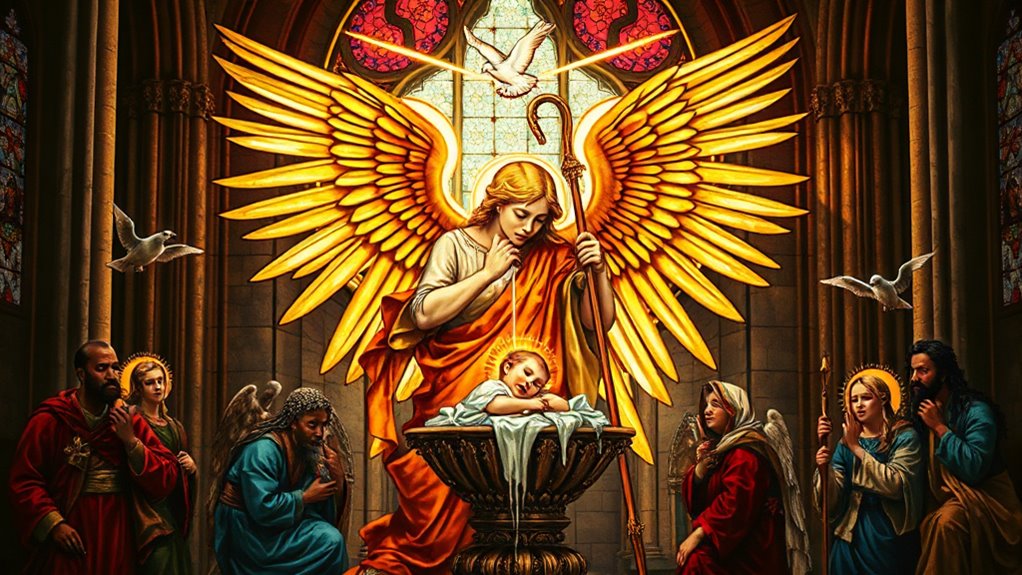
Catholic teaching holds that each believer has an angel as protector and shepherd, though this is traditional teaching rather than formal dogma. Church tradition holds that providence assigns an angel to each person for the journey on earth, not only the baptized, a view grounded in Tobit and Matthew 18:10. The Church also sees angels as caring for a person’s inner life in ways that reflect God’s providential care.
The Church marks the Feast of the Holy Guardian Angels on October 2 and permits prayers to them, distinct from worship of God. Saint Thomas Aquinas taught in the Summa Theologica that an angel guardian is appointed at birth, leading a person “on a road” toward heaven.
Eastern Orthodox Christians likewise affirm a personal angelic protector, often linked to baptism, and some traditions address prayers directly to that angel.
Protestants vary; Calvin hesitated over assigned angels, and most pray to God instead.
Do Non-Baptized People Have Guardian Angels Too?
Although the Catechism speaks of “every one of the faithful” having an angel “as educator and guide,” Catholic teaching has never declared that only the baptized receive this protection.
A common view, described as the general teaching of theologians, holds that every person has a guardian angel from birth. Suárez described the position that infidels and the unbaptized also have guardian angels as the “communis sententia” of theologians and Fathers.
St. Jerome is often cited for the idea that God assigns a protecting angel to each soul, and sources summarizing St. Thomas Aquinas say the assignment begins at birth, with baptism strengthening the angel’s role rather than creating it. Baptism itself is the gateway to the other sacraments, bringing rebirth as children of God and incorporation into the Church.
The universal view is widely taught, though it is not formally defined. This teaching is often balanced with calls for discernment and humility when applying beliefs about angels to pastoral practice.