Eternal life, according to Scripture, is far more concrete and satisfying than most people imagine. It involves renewed physical bodies modeled after Christ’s resurrected form, a fully restored creation, and a rich relational knowing of God that begins at the moment of belief, not at death. Titus 3:4–7 frames this inheritance as secured entirely by grace, guaranteed by the Holy Spirit. Those who explore this topic further will find the full picture even more remarkable.
What Does Eternal Life Actually Look Like?
Eternal life, as described in Scripture, looks nothing like the popular image of souls drifting through clouds in white robes. Instead, it involves genuine physical existence — renewed bodies capable of seeing, hearing, touching, tasting, and smelling. These bodies will not creak, wrinkle, or break down.
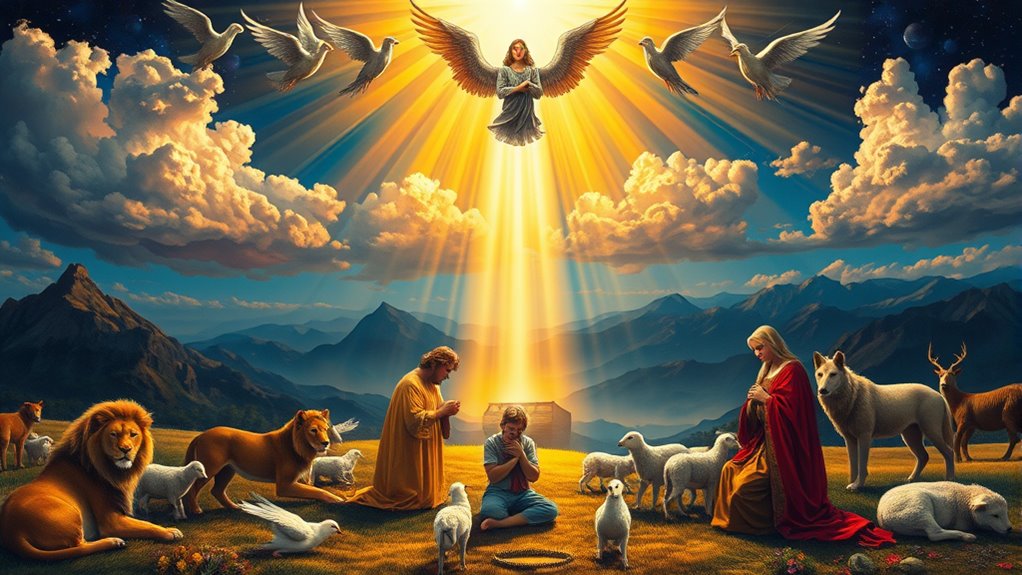
The setting is described as more wonderful than anything currently imaginable, a place where humanity exists in its most complete form. Scripture presents this not as a vague spiritual state but as a tangible, physical reality — perfectly human people inhabiting a perfectly renewed world, fully restored and unmarked by decay or limitation. Revelation depicts a beautiful city with grand walls, gates, a garden-oasis, a crystal river, and fruit-laden trees. The tree of life, once barred from humanity after the fall in Eden, will be fully restored and accessible, offering its leaves for the healing of nations. Many passages across both the Old and New Testaments emphasize this future as the culmination of God’s plan for creation and redemption, promising a new creation that undoes decay and death.
Why Eternal Life Far Exceeds Your Expectations
Most people’s expectations of eternal life fall well short of what Scripture actually describes. Many assume it simply means living longer, but the biblical picture is markedly different.
Eternal life, according to John 5:24, begins at the moment of belief, not at death. It carries God’s own supernatural quality, something no human effort can produce. It continues unbroken through physical death, which Scripture frames as a passage rather than an ending. It concludes with bodily resurrection.
Meanwhile, 2 Corinthians 4:18 notes that an eternal perspective reshapes daily priorities, producing purpose and steadiness throughout ordinary life. Paul expressed this confidence even while living on the brink of death, anticipating the crown of righteousness that awaited him beyond this life.
John 17:3 defines eternal life not merely as unending existence but as knowing God intimately, a present-tense relational reality available to every believer now, not reserved for heaven alone. Added to this, biblical hope is a confident expectation grounded in God’s character and promises rather than mere wishful thinking.
Glorified Bodies, Rewards, and Sharing Christ’s Kingdom
Scripture’s description of eternal life moves beyond a starting point and an unbroken timeline into something far more concrete: a physical existence permanently transformed. Believers, according to biblical teaching, receive glorified bodies modeled after Christ’s resurrected form—recognizable, physical, and incorruptible. These bodies will be imperishable, honorable, and powerful, suited for eternity rather than the limitations of fallen earthly existence. At physical death, the soul separates from the body and awaits a new eternal house, the glorified body promised to every believer at resurrection. The Bible also emphasizes God’s compassionate care for the suffering and the hope of complete restoration in eternity, including healing and care as ongoing realities.
Eternal life isn’t merely endless time—it’s a permanent, physical transformation modeled after Christ’s glorified, resurrected body.
Beyond that transformation, eternal life includes:
- Glorified bodies free from sickness, decay, and sin’s limitations.
- Five crowns awarded at the Judgment Seat of Christ for faithful service.
- Rewards reinvested into Christ’s glory rather than retained personally.
- Shared rulership with Christ over the renewed heavens and earth.
How God’s Grace Guarantees Your Eternal Inheritance
Titus 3:4–7 lays out a carefully structured case for how believers come to possess eternal life, and the logic of that case rests entirely on grace rather than personal merit.
Justification by grace positions believers as heirs according to the hope of eternal life. That inheritance, described in 1 Peter 1:4, cannot perish, spoil, or fade, and remains kept in heaven. Acknowledging ancient funerary customs and biblical perspectives can help clarify how Scripture treats the destiny of the saved burial and cremation.
The Holy Spirit, according to Ephesians 1:13–14, seals believers as God’s own, serving as a guarantee until full possession arrives. The seal imagery carries the weight of preservation, ownership, and authority, signaling that believers belong to God rather than to themselves.
Christ, as mediator of the New Covenant in Hebrews 9:15, assures heirs ultimately receive what grace promised. Believers are shielded by God’s power through faith until that promised salvation is fully revealed in the last time.
How God Transforms You Now to Prepare You for Eternal Life
Knowing that grace secures an eternal inheritance raises a practical question: what does God do in a believer’s life right now to prepare that person for what is coming?
Scripture identifies four concurrent works:
- The Holy Spirit indwells believers, producing love, peace, and growing maturity.
- God’s Word renews the mind, redirecting focus from temporary concerns toward eternal realities.
- Character is reshaped through holiness pursuits, creating lives that withstand spiritual testing.
- Time, talents, and resources invested in eternal purposes yield lasting impact beyond temporal satisfaction.
Together, these works confirm that eternal life is not only future—it begins transforming a person today. The Bible provides the authoritative foundation for this confidence, as 1 John 5:13 assures believers they can know—not merely hope—that they possess eternal life. As Ecclesiastes 3:11 reminds us, God has placed eternity in the human heart, meaning every person is made to last forever and is already oriented toward the eternal destiny that these present works are preparing them to receive. God’s present comfort and ongoing transformation also call Christians into mutual support as they grieve, grow, and serve together.