

Turkish archaeologists uncovered a third-century fresco of Jesus inside a sealed underground tomb at the Hisardere Necropolis near Iznik, ancient Nicaea. The image depicts a youthful, clean-shaven Christ in a Roman toga, carrying a goat, with two additional goats flanking him. Experts rank it among the five oldest known adult images of Christ. Its near-perfect pigment survived roughly 1,800 years in an oxygen-depleted environment. The full story behind this remarkable find runs deeper than it first appears.
The 1,800-Year-Old Jesus Fresco Discovered in Iznik, Turkey
Turkish archaeologists recently uncovered a striking piece of early Christian history beneath the ground near Iznik, a town in northwestern Turkey historically known as Nicaea.
Inside a sealed underground tomb within the Hisardere Necropolis, researchers discovered a fresco dating to the early-to-mid 3rd century AD.
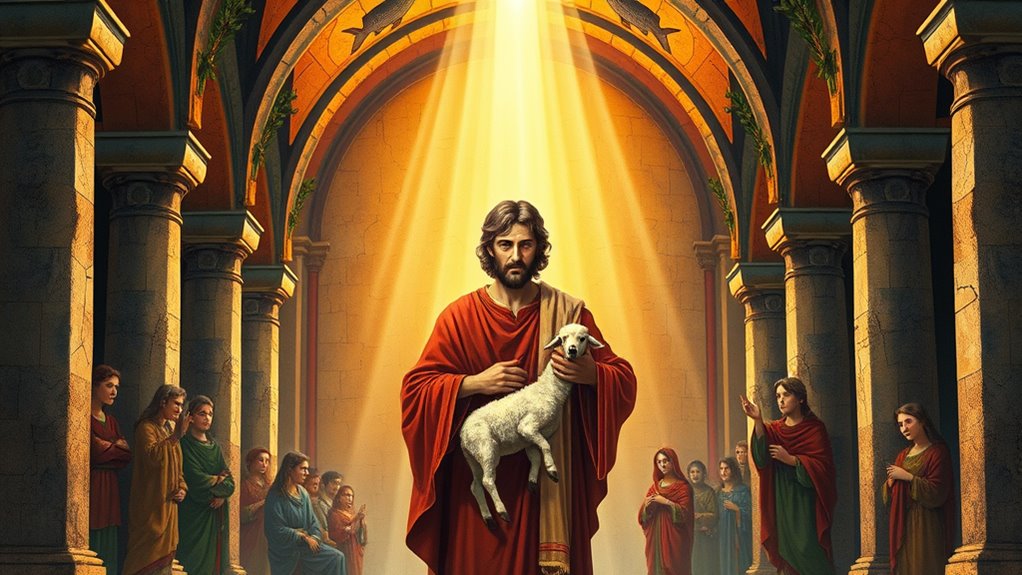
The painting depicts a youthful, clean-shaven Jesus dressed in a Roman toga, carrying a goat across his shoulders while two additional goats flank him on either side.
The tomb’s oxygen-depleted environment preserved the pigments in near-perfect condition, allowing researchers to observe original colors and fine details virtually unchanged after approximately 1,800 years.
This fresco ranks among the five oldest images of Christ as an adult discovered anywhere in the world.
Notably, the ancient city of Nicaea would later become the site of the First Council of Nicaea in A.D. 325, where foundational Christian doctrine was established and what became known as the Nicene Creed was produced.
Scholars note that such imagery often reflects early Christian themes of pastoral care and moral instruction connected to teachings about purity and conduct.
Where Iznik Fits in Christianity’s Earliest History?
Beyond its role in the fresco discovery, Iznik carries a much deeper place in Christian history as the ancient city of Nicaea. Located in northwest Asia Minor, the city shaped the foundations of Christian doctrine long before the fresco was painted.
Three milestones define Nicaea’s early Christian significance:
- Emperor Constantine I convened the First Council of Nicaea in 325 AD
- The council produced the Nicene Creed, affirming Jesus as “begotten, not made”
- Arianism was declared heretical, unifying early Church doctrine
That theological legacy still echoes in Christian worship worldwide today. A second council held in Constantinople in 381 AD adopted an expanded Nicene Creed, adding language about the Holy Spirit, the Son’s humanity, and the world to come.
At the heart of the Arian controversy was the teaching of Arius, who argued that Jesus was a created being and therefore not co-eternal with God the Father.
The councils’ decisions were aimed at protecting the Church from false teaching and clarifying orthodox belief.
What the Good Shepherd Fresco Reveals About Early Christians in Nicaea?
Discovered beneath the ancient city of Nicaea, the Good Shepherd fresco offers a rare window into how early Christians in northwest Anatolia expressed their faith before doctrine was formalized or worship was legally protected.
Painted in the third century, decades before the Edict of Milan and the First Council of Nicaea, the image shows a youthful, beardless Jesus carrying a ram, flanked by goats and a date palm. The presence of animal imagery also echoes how dogs and other animals appear in Scripture and early Christian art as symbolic figures.
The fresco suggests these early believers used familiar Roman funerary imagery to communicate Christian meaning quietly, at a time when open worship carried real risk under Roman rule. The tomb’s other frescoes also depict an aristocratic couple on a funerary platform and a symposium with servants, reflecting how Christian and Roman traditions intermingled in burial spaces of the era.
Scholars note that the Good Shepherd motif was extraordinarily widespread in Rome, with 114 known representations documented in the Roman catacombs alone, making the Nicaean discovery all the more striking as the only known example of this Christian motif found outside Italy.
Why This Image of Christ Survived Almost Perfectly?
When archaeologists uncovered the Good Shepherd fresco beneath Iznik in 2020, they found it in a condition that surprised even experienced researchers: colors intact, details preserved, the plaster surface largely undamaged after roughly 1,800 years underground.
Several conditions worked together to protect it:
- The sealed tomb was oxygen-depleted, preventing oxidation and blocking mold, bacteria, and insects.
- Total darkness eliminated ultraviolet and visible light, stopping the photochemical reactions that fade pigments.
- Earth-based pigments like red ochre, mixed with durable binders, resisted chemical breakdown across centuries.
The tomb’s durable masonry held firm, keeping water and soil out throughout. The image also predates the period when pictorial depiction of Jesus reached a standardized conventional form, making its survival an especially significant window into early Christian visual practice.
Early Christian tradition held that the first true image of Christ was sent to Abgar V Ukhama, the leprous prince of Osroene, after Christ pressed a linen cloth to his face and left his features miraculously fixed upon it.
Such discoveries also invite reflection on biblical themes of heaven as God’s dwelling place and how early Christians envisioned divine presence in art and worship.
How the Iznik Fresco Fits Into Turkey’s Larger Early Christian Archaeological Record
The same qualities that kept the Good Shepherd fresco so well preserved also make it scientifically valuable — not just as an object, but as a data point within a much broader archaeological record.
Turkey holds unusual historical weight in early Christianity; scholars consider the region the second cradle of Christianity after Jerusalem. Yet physical evidence from that period remains scarce. This scarcity contrasts with the Bible’s emphasis on the formation of early Christian communities and the role of marriage and household life in transmission of faith, including teachings that affirm sexual intimacy within the covenant of marriage as a good, God-given gift Sexual intimacy.
The Iznik fresco is currently the only known Good Shepherd representation in Anatolia, filling a significant gap.
Alongside the Hisardere necropolis, which served communities from the 2nd through 5th centuries, it helps clarify how Christianity quietly took root in Roman-era Anatolia. The fresco’s significance was underscored when Turkish President Erdogan presented a tile painting of the discovery to Pope Leo XIV during his visit to Iznik last month.