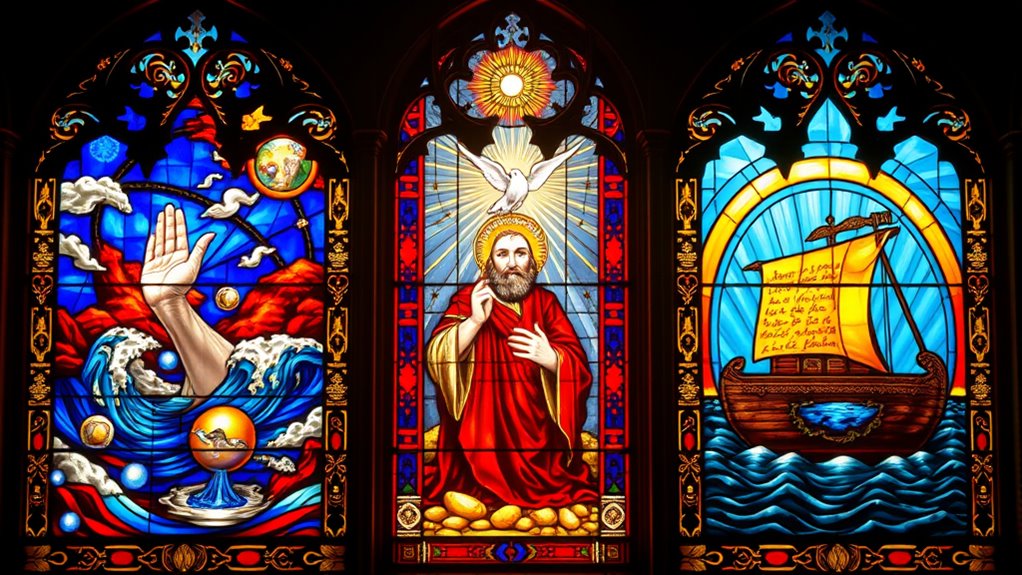
Genesis entered a world already shaped by violent creation stories, including the Babylonian *Enuma Elish*, where the god Marduk defeats the chaos figure Tiamat and forms the cosmos from her body. Against that backdrop, Genesis replaced divine combat with ordered speech, using the repeated formula “And God said” to bring creation into being. It also extended sacred dignity to all people through the image of God. Exploring further reveals how deliberately these shifts were made.
Why Were the Creation Myths Genesis Challenges So Violent?
Before Genesis offered its account of creation, the ancient Near East already had a rich tradition of stories that explained the world’s origins through bloodshed and conquest. The Babylonian *Enuma Elish*, for example, describes the world emerging from violent battle, with the god Marduk defeating the chaos figure Tiamat and reshaping her body into the cosmos. Scholars call this pattern *Chaoskampf*, meaning combat against chaos. These myths reflected a broader assumption: that force was the fundamental principle behind reality. Order, in that worldview, could only exist because someone had won a war. In the *Enuma Elish*, human beings themselves were fashioned from the blood of Kingu, Tiamat’s second husband, meaning that humans were born of violence and created specifically to free the gods from menial labour. Genesis 1–2, by contrast, present creation without violence, with humans appointed as caretakers charged with maintaining a harmony that extended across the whole of creation. The Bible also frames Scripture as authoritative and intended for teaching and correction to guide believers in faith and life.
How Did Genesis Replace Combat With Ordered Speech?
The contrast between Genesis 1 and the older Near Eastern creation stories comes down to a single, striking difference: where those myths required violence to explain the world, Genesis required only a voice.
The chapter’s repeated formula, “And God said,” places speech at the center of every creative act.
- No divine battle occurs
- No rival deity is defeated
- Elements like sea and darkness are commanded, not conquered
- Order emerges through separation and naming
The world Genesis describes is not a cleared battlefield but a structured cosmos, shaped by language and arranged quietly for life. In the Enuma Elish, Marduk builds the world using the body of the slain goddess Tiamat, a foundation of violence Genesis deliberately leaves behind.
Scholars have noted that tehom, the Hebrew word for “the deep” in Genesis 1:2, was once thought to derive from the divine name Tiamat, though tehom reflects common Semitic roots for ocean or depth rather than a borrowed deity name. The depiction of a structured cosmos also connects to ancient ideas about a firmament as a dome separating waters above and below.
What the Image of God Really Changed
Where Genesis 1 replaced divine combat with ordered speech, it also introduced a claim about human beings that carried equally far-reaching consequences.
Ancient Near Eastern cultures typically reserved sacred status for kings alone. Genesis extended that status to every person, male and female alike, describing all humanity as bearing the image of God.
This single shift reframed human worth from usefulness to intrinsic dignity, made governance a moral responsibility rather than unchecked power, and established that harming another person meant offending divine likeness itself.
Human identity was no longer defined by rank, but by something each person already carried. Unlike the rest of creation, humanity alone received both a material body and an immaterial soul, making humans uniquely capable of communion with God.
Scholars have long debated whether the image of God refers to shared characteristics such as rationality or morality, to humanity’s relationship with God and others, or to a functional role representing God in creation, with each view offering distinct but complementary insight.
This theological affirmation also undergirds a biblical call to racial unity by affirming the equal value of all people across ethnic and cultural divides.
Where Genesis Drew From Ancient Myths: And Where It Broke From Them
Ancient Near Eastern civilization produced a rich body of creation and flood narratives long before Genesis took its final form, and scholars have spent well over a century mapping the connections between those texts and the biblical account. Genesis clearly borrowed familiar structures while quietly redirecting their meaning.
Ancient Near Eastern myths shaped Genesis, which borrowed familiar structures and quietly redirected their meaning.
Key shared and divergent elements include:
- Both Genesis and Enuma Elish move from primordial waters toward ordered creation
- *Gilgamesh* and *Atrahasis* share flood details nearly identical to Noah’s story
- Genesis removes divine conflict, pantheon politics, and cosmic warfare
- Flood motivation shifts from divine annoyance to moral accountability
In the *Atrahasis* epic, humans are created from the flesh and blood of a slaughtered god mixed with clay, whereas Genesis describes mankind as formed from dust and animated by the breath of God.
Scholars such as Heidel, Millard, and Tsumura have argued that the biblical writers were not simply copying or borrowing from these earlier mythological texts, but were instead reframing inherited traditions with a distinct theological vision. The biblical narrative also situates these themes within Israel’s covenantal history, giving them a communal and historical focus rather than merely mythic origins.