



The Bible does not explicitly forbid a second baptism, but Ephesians 4:5 sets “one Lord, one faith, one baptism” as the standard, and most traditions treat a valid Trinitarian baptism as unrepeatable. Acts 19 records Paul baptizing about twelve men who had received only John’s baptism, an exception tied to a specific situation. Questions of baptism validity decide most cases.
Key Takeaways
- Ephesians 4:5 presents baptism as a single foundation of Christian unity, not a repeatable ceremony.
- Acts 19 is a limited precedent about men who knew only John’s baptism, not a universal command.
- A first baptism may be judged invalid because of a wrong formula, a wrong substance or a missing intention, so a later baptism counts as the first valid one.
- Traditions differ: Catholic and Reformed churches do not repeat a valid Trinitarian baptism, while Baptist and Anabaptist groups often reject infant baptism.
What the Bible Says About Being Baptized Twice

When the New Testament addresses baptism directly, it presents the practice as a single event rather than a repeatable one. Paul lists it among the foundations of Christian unity.
There is one body, and one Spirit, even as you also were called in one hope of your calling; one Lord, one faith, one baptism, one God and Father of all, who is over all, and through all, and in us all.
Ephesians 4:4-6 (WEB)
In this passage the one baptism sits beside one body, one Spirit and one God. Commentators commonly describe baptism as entry into the Christian community, tied to identification with Christ’s death, burial and resurrection. That framing supports a decisive beginning rather than a recurring ceremony, and the New Testament gives no clear pattern of believers returning for a second water baptism later in life.
The same passage that names one baptism also names one Lord, one faith, so baptism belongs to a set of foundational truths rather than standing as an isolated act. Some commentators describe it as a sacramental seal of faith, the outward expression of the saving trust a believer places in Christ.
Early Christians understood Jesus as both divine and distinct from the Father, a belief that influenced baptismal practice and the formulation of the Trinity.
Does Acts 19 Actually Permit a Second Baptism?

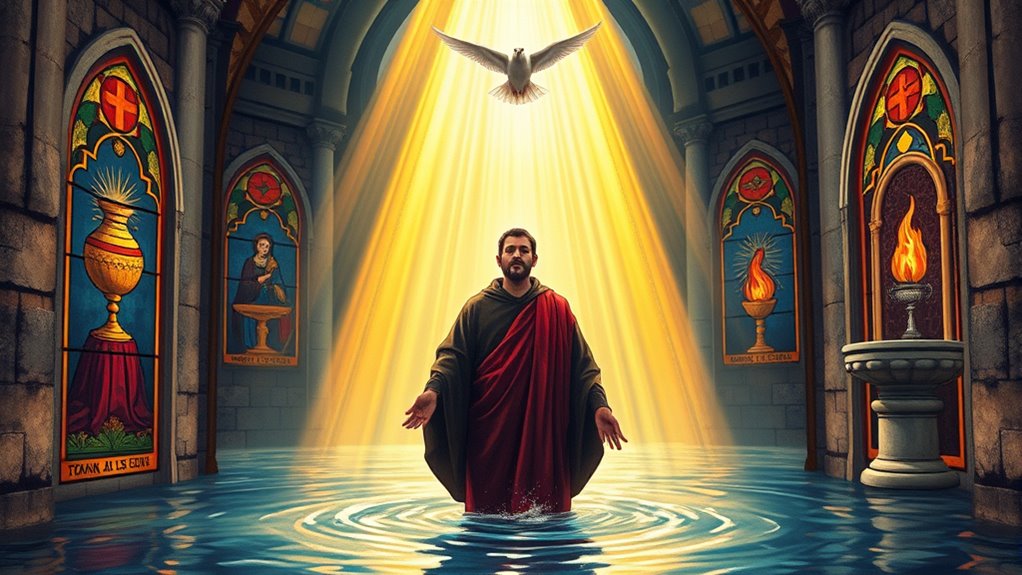
Acts 19 is the passage most often cited in debates about a second baptism. Paul meets roughly twelve men in Ephesus who had received only John’s baptism.
Paul said, “John indeed baptized with the baptism of repentance, saying to the people that they should believe in the one who would come after him, that is, in Jesus.” When they heard this, they were baptized in the name of the Lord Jesus.
Acts 19:4-5 (WEB)
Paul explains that John’s baptism pointed toward belief in Jesus, so these men had incomplete instruction about His completed work. After hearing this, they were baptized in the name of the Lord Jesus. This is the pattern often called Pauline rebaptism.
The passage permits a second baptism in this specific situation, but it does not command all Christians to be baptized again. It addresses a shift from pre-Christian initiation to full Christian baptism, so it is a limited precedent rather than a broad rule. Afterward Paul laid hands on the men, and the Holy Spirit came upon them, and they spoke in tongues and prophesied.
Some readers count this as the fifth time Luke links John the Baptist and Jesus in Acts, a pattern that underscores the move from John’s preparatory ministry to the fullness of Christian faith.
What Makes a First Baptism Invalid Enough to Warrant Another?

Not every baptism performed in a church setting is automatically valid. Catholic theology identifies three core requirements: water as the essential matter, the correct baptismal words as the essential form, and proper intention from the minister. If any element is missing, the rite may not count at all.
Using “We baptize you” instead of “I baptize you” alters the ministerial subject enough to invalidate the sacrament. Substituting another liquid for water creates a similar problem. A minister who performs the rite purely as symbolic theater, without proper intention, can also produce an invalid result. In such cases a later baptism is not a repetition but a first valid one.
Replacing the names Father, Son and Holy Spirit with titles such as Creator, Sanctifier or Liberator also produces an invalid result, because these substitutions fail to adequately express Trinitarian faith. The Congregation for the Doctrine of the Faith addressed these formula concerns in responses issued in 2008 and 2020, concluding that altered formulas affect the validity of the sacrament itself.
Why Ephesians 4:5 Settles the Question of One Baptism
Once the conditions for an invalid baptism are set aside, a broader question remains: how many times does Scripture say a person should be baptized? Ephesians 4:5 gives the clearest answer, placing baptism alongside singular realities that define Christian identity.
Scholars at Bible.org note that this “one baptism” refers to water baptism as a public confession of unity and a marker of identity within the community of believers. The verse does not address procedural exceptions, but its theological weight is steady. Translations from the ESV to the ERV render one Lord, one faith consistently, and versions such as the KJV, NASB2020 and CSB also affirm one God and Father, who is over all, through all and in all. That grounds the singularity of baptism in the unity of God himself.
How Different Christian Traditions Handle Rebaptism

Christian traditions do not share a single answer on whether a baptized person should be baptized again. Their differences reflect deeper disagreements about what makes a baptism valid in the first place.
Catholic and Reformed churches, drawing on church history, treat a prior Trinitarian baptism as unrepeatable. Eastern Orthodox communities vary by jurisdiction, sometimes receiving converts through chrismation rather than rebaptism. Baptist and Anabaptist traditions often reject infant baptism as invalid and require baptism after a personal profession of faith.
Some evangelical groups permit rebaptism as a sign of renewed commitment. Seventh-day Adventists also rebaptize persons who turned from God into open sin but now wish to rejoin church membership. Pastoral guidance across these traditions tends to ask whether the original baptism met the community’s standards for intention, formula and faith.
The First Council of Constantinople in 381 directed that repentant heretics returning to the church be received through anointing with oil rather than rebaptism.
Common Questions About Being Baptized Again
Does the Bible command a second baptism for anyone?
No. The only recorded case is the group in Acts 19, and it concerns men who had received John’s baptism before learning of Jesus. It is treated as a limited precedent, not a rule for all believers.
Is a baptism with the wrong words still valid?
Catholic teaching says no. Altered formulas, such as replacing Father, Son and Holy Spirit with other titles, affect the validity of the sacrament. In that view a later baptism is a first valid one, not a repetition.
Why do some churches rebaptize people who were baptized as infants?
Baptist and Anabaptist traditions often hold that infant baptism is not valid, because baptism should follow a personal profession of faith. From their perspective, the adult baptism is the first real one.
Thinking Through Baptism and Your Own Situation
If you are unsure about your own baptism, start by asking what your church tradition requires for validity, and speak with a pastor or priest about how your baptism was performed. The answer often depends less on a single verse than on how your community understands the rite.