



The Bible presents judgment as far broader than punishment. The Hebrew word *mishpat* refers to legal rulings and the exercise of justice, while New Testament terms like *krima* and *krisis* cover verdicts, discernment, and accountability. Scripture describes God as the supreme judge who evaluates hidden motives, spoken words, and visible actions alike. Hebrews 9:27 confirms all people face judgment after death. Those exploring what this means for eternity and daily life will find the fuller picture ahead.
Key Takeaways
- Biblical judgment (*mishpat*) means more than punishment—it encompasses justice, discernment, accountability, and legal verdicts across both Testaments.
- God’s judgment is all-encompassing, covering hidden deeds, secret motives, inner intentions, and even every careless word spoken.
- Revelation 20:11–15 describes a final Great White Throne judgment where all people are held permanently accountable for their actions.
- Hebrews 9:27 confirms every person dies once and then faces judgment, making it a universal and certain event.
- Daily life should reflect awareness of judgment through self-examination, righteous speech, merciful treatment of others, and faithful stewardship.
What Does the Bible Actually Mean by Judgment?

When most people hear the word “judgment,” they tend to think of punishment or condemnation. The Bible, however, presents a broader and more nuanced meaning.
The Hebrew word *mishpat*, frequently translated as judgment, refers to a legal ruling, a judicial decision, or the exercise of justice. In the New Testament, Greek terms like *krima* and *krisis* carry similar weight, covering verdicts, discernment, and accountability. Aramaic and Greek were both part of the linguistic world of early Christianity, shaping how these concepts were discussed in different communities, so readers should note the linguistic context.
Biblical judgment centers on testing, evaluating, and rendering a decision, not simply punishing wrongdoing. It also includes moral and spiritual discernment.
God’s role as supreme judge shapes much of this concept throughout Scripture. Understanding this fuller meaning allows readers to approach biblical passages about judgment with greater accuracy, recognizing that evaluation, fairness, and justice are central to what the term actually describes. Scripture also reveals that all judgment has been given to the Son, with the Father having entrusted this authority entirely to Jesus Christ.
This judgment is described as universal, certain, and righteous, and it carries eternal consequences for all who stand before God, as affirmed throughout both the Old and New Testaments.
Does God Really Judge Your Words and Hidden Actions?

Having established what the Bible means by judgment in its broadest sense, the natural next question is how far that judgment actually reaches.
According to Ecclesiastes 12:14, every deed enters judgment, including hidden ones, whether good or evil.
Every deed, hidden or visible, good or evil, falls under divine judgment without exception.
Romans 2:16 extends this further, stating that God judges the secrets of men through Jesus Christ, which commentaries connect to motives, intentions, and inner desires.
Matthew 12:36 adds another dimension, teaching that people will account for every careless word spoken.
Luke 8:17 reinforces the broader principle, describing hidden things as eventually made known. Multiple translations render this scope consistently, affirming that God will evaluate every act and secret, whether good or evil.
Hebrews 4:13 states that nothing is hidden from God’s sight, with all things uncovered and exposed before him.
Taken together, these passages present a consistent picture: biblical judgment covers external actions, private conduct, spoken words, and inner life, leaving no area outside divine awareness or accountability. This comprehensive view aligns with the Christian doctrine that Jesus, as the Son sharing divine authority, participates in divine judgment.
What Does the Bible Say About Final Judgment?

Beyond the reach of divine judgment into hidden words and actions lies a wider reckoning that Scripture calls the final verdict. Revelation 20:11–15 describes a great white throne before which the dead, regardless of status, stand to be judged. Reading the whole Bible takes only a modest time investment, roughly 70–80 hours, which many find manageable for studying such teachings.
Two types of records appear: books detailing each person’s deeds and a separate book of life. Those absent from the book of life face the lake of fire, described as the “second death.”
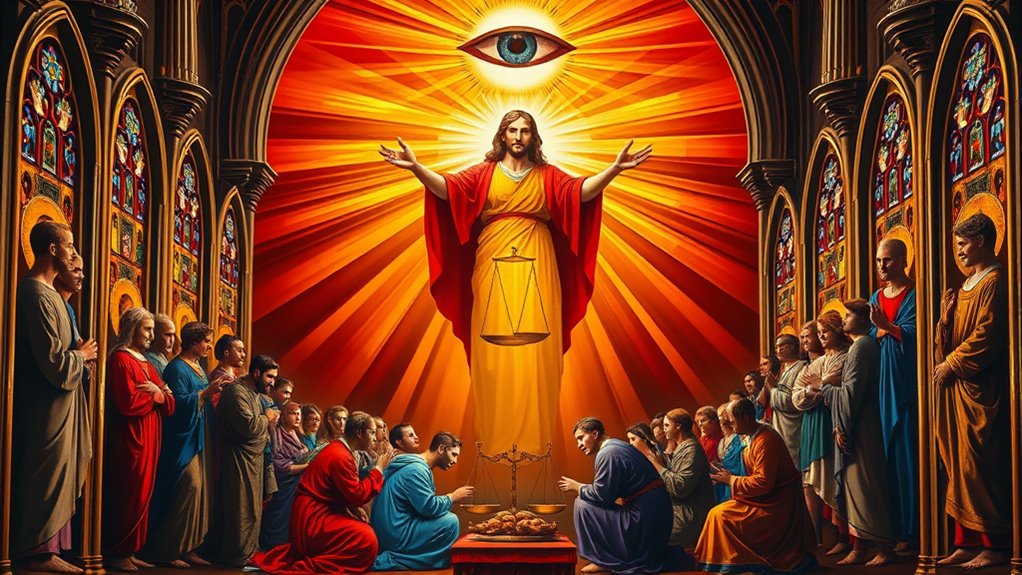
Matthew 25:31–46 places Jesus as the central judge, separating people into two groups based on their actions. The outcomes are permanent—eternal life for some, eternal punishment for others. In this scene, Jesus separates sheep from goats, placing the sheep on his right and the goats on the left.
The New Testament presents this event not to frighten, but to encourage faithful, accountable living while time remains. Hebrews 9:27 affirms that all people die once and then face judgment, underscoring the urgency of choices made during physical life.
How Should Biblical Judgment Shape the Way You Live?

Scripture’s teachings on judgment are not meant to remain abstract; they are designed to shape daily behavior in concrete ways.
Matthew 7:1-5 places self-examination before correction, reminding individuals to address personal faults before critiquing others. Regular reading plans help make that self-examination a habit by encouraging steady, manageable engagement with Scripture.
John 7:24 calls for righteous judgment grounded in truth rather than appearances or social pressure.
Luke 6:37 connects merciful treatment of others with receiving mercy in return.
Matthew 12:36 identifies careless speech as morally accountable, while Ephesians 4:29 encourages words that build rather than damage.
Romans 14:10-12 reminds each person that they answer individually to God, discouraging comparison and self-justification.
Luke 16:10-13 frames life as stewardship, making ordinary decisions carry moral weight.
Proverbs 1:7 teaches that fear of the LORD is the beginning of knowledge, anchoring all pursuit of wisdom in reverent accountability before God.
Believers are further called to calibrate their motives in light of Hebrews 4:13, which declares that nothing in all creation is hidden from God’s sight.
Together, these passages present judgment as a quiet, ongoing discipline shaping speech, relationships, and daily choices.