



The St. Benedict Medal is a Catholic sacramental that grew from a simple cross into a standardized medal, and Pope Benedict XIV formally approved it in 1742. Catholics wear it as a prayerful sign of protection against evil, darkness and temptation. This article explains where it came from, what its inscriptions say, and how the Church understands it.
Key Takeaways
- The medal developed gradually within Benedictine devotion; St. Benedict himself never designed it.
- Its protective reputation rests on legends of poison and temptation, not on a biblical command.
- The inscriptions are prayers asking for Christ’s light and protection from Satan.
- Catholics describe it as a sacramental whose effect depends on faith, not on the metal.
Where the St. Benedict Medal Really Comes From
The medal traces its roots to St. Benedict of Nursia, who lived from 480 to 547 AD and founded the Benedictine monastic order. He never designed a medal himself. The object developed slowly through Benedictine devotional practice, beginning as a cross before evolving into a standardized medal.
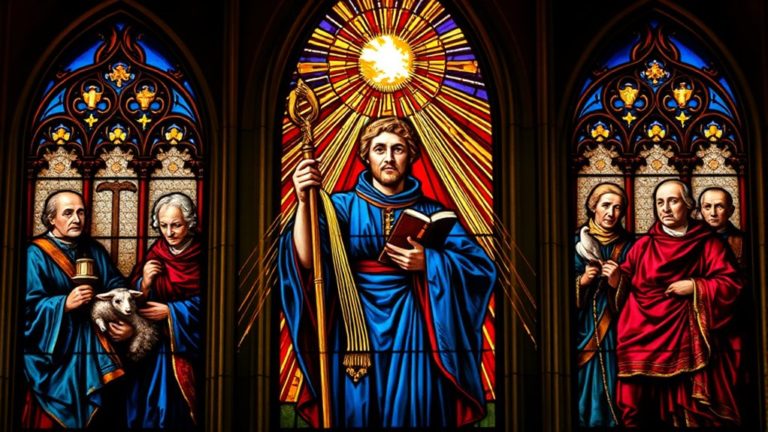
The earliest confirmed historical anchor appears in 1647, when evidence connected the medal’s inscriptions to a 1415 manuscript discovered at Metten Abbey in Bavaria. That medieval German document helped clarify the medal’s meaning. The manuscript depicted St. Benedict holding a staff and scroll, whose full words matched the mysterious letters on the medal.
The current design, known as the Jubilee Medal of Montecassino, was created in 1880 under the supervision of the monks of Montecassino to mark the 1400th anniversary of St. Benedict’s birth.
The Legends of Poison and Protection That Shaped Its Reputation
The legends most responsible for the medal’s protective reputation involve two attempts to poison Benedict. In one account, hostile monks offered him a cup of poisoned wine. He made the Sign of the Cross, and the cup shattered. In another, a raven carried away a poisoned loaf of bread before he could eat it. These stories framed Benedict as someone who resisted both physical harm and spiritual malice.
Over time, Catholic tradition extended the medal’s protective association beyond poison to curses, disease, evil and temptation. The medal was formalized in the 17th century, when the Church recognized its inscriptions as a sacramental against evil and devilish temptations.
Another legend concerns Bruno of Egisheim-Dagsburg, the future Pope Leo IX. He credited a vision of St. Benedict holding a radiant cross with healing him after a snake bite. These accounts come from later Catholic tradition rather than from Scripture.
The Bible itself speaks of resisting the devil through God, not through objects:
Be subject therefore to God. Resist the devil, and he will flee from you.
James 4:7 (WEB)
Catholic teaching places the medal within this idea: it is meant to prompt prayer and trust in God. Some Christians outside the Catholic tradition remain wary of such objects and point to biblical warnings about consulting mediums and spiritists.
What Do the Symbols and Inscriptions on the Medal Mean?
The medal carries a precise visual and textual program. The front shows Benedict holding a cross and the Rule of St. Benedict, surrounded by the Latin petition Eius in obitu nostro praesentia muniamur, a request for protection at the moment of death. Many Christians wear similar sacramentals as reminders of faith, often emphasizing inner devotion over reliance on objects as a source of grace.
The cross bears C.S.P.B., identifying it as Benedict’s own. Along its arms run C.S.S.M.L. (“May the Holy Cross be my light”) and N.D.S.M.D. (“May the dragon not be my guide”).
The reverse adds V.R.S.N.S.M.V.S.M.Q.L.I.V.B.: “Begone, Satan; never tempt me with vanity; drink your own poison.” Above the cross, the word PAX sometimes appears, a Latin word for peace. The medal’s official name is the Medal of the Holy Cross, a title that underscores its emphasis on Christ rather than on Benedict himself.
The phrase “Begone, Satan” echoes the words of Jesus when he was tempted in the wilderness:
Then Jesus said to him, “Get behind me, Satan! For it is written, ‘You shall worship the Lord your God, and you shall serve him only.’”
Matthew 4:10 (WEB)
The inscription borrows this idea of rejecting the tempter directly.
Pope Benedict XIV and the 1742 Approval
When Pope Benedict XIV approved the medal in 1742, a regional devotion became a recognized Catholic practice. The papal brief, dated March 12, 1742, granted formal ecclesiastical approval, responding to growing devotion and the skepticism of the era. He also authorized a specific blessing form and granted indulgences to those who wore the medal with faith.
Following approval, medals were struck widely in Germany and spread across Europe. The medal came to be regarded in Catholic circles as one of the most powerful sacred objects, particularly for those on the deathbed.
Devotion had earlier roots as well. According to a later tradition, Brunone of Alsace was healed through St. Benedict’s intercession in the early 11th century and later became Pope Leo IX, which helped spread devotion to the saint’s cross long before the medal took its documented form.
What the St. Benedict Medal Means in Modern Catholic Devotion
Today, Catholics understand the medal as a sacramental, a visible sign of prayer and trust in God’s protection, not a charm. Devotional sources explain that its effectiveness comes from faith, not metal. Modern Catholics find meaning in three ways:
- Wearing it daily as a reminder to reject evil and stay faithful
- Placing it in homes as a sign of blessing and protection
- Using it during struggle to seek peace, courage and spiritual firmness
The back of the medal features a cross surrounded by Latin abbreviations, including the phrase Vade Retro Satana, meaning “Begone Satan, do not suggest to me thy vanities.” Saint Benedict, known as the father of Western monasticism, authored the Rule of St. Benedict and left a legacy of humility, steady prayer and trust in Christ.
Common Questions About the St. Benedict Medal
Is the medal a magic charm?
Catholic teaching says no. It is a sacramental, a sign meant to lead the wearer to prayer and trust in God. Devotional sources stress that any effect comes from faith, not from the metal.
Does the medal come from the Bible or from tradition?
It comes from tradition. The stories of the poisoned cup, the raven and Pope Leo IX are later Catholic accounts, and the medal’s form developed within Benedictine devotion. Some non-Catholic Christians therefore question the practice, while Catholics see it as consistent with Scripture’s call to resist evil.
Wearing the Medal With Understanding
The medal’s inscriptions ask for Christ’s light and for strength against temptation. Whatever one’s tradition, the most useful takeaway is the prayer behind it: trust in God, and a firm refusal of evil.